
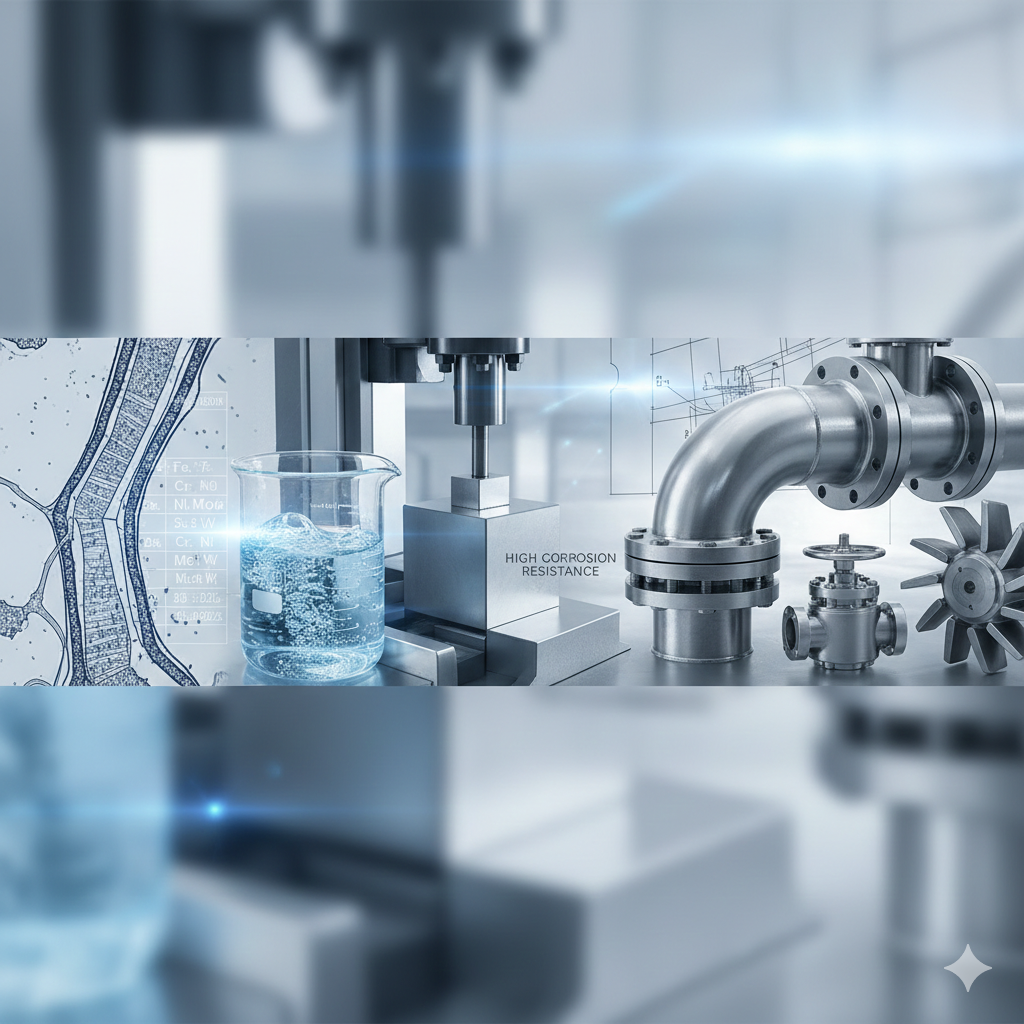
Among the elite materials engineered to withstand the most aggressive industrial environments, UNS S32760 super duplex stainless steel stands as a remarkable achievement in metallurgical design. Combining the advantageous characteristics of both austenitic and ferritic stainless steels while minimizing their individual weaknesses, S32760 delivers exceptional corrosion resistance, superior mechanical strength, and proven performance in applications where conventional stainless steels fail. This comprehensive examination explores the composition, microstructure, properties, and engineering advantages that make S32760 a material of choice for critical applications in offshore oil and gas, chemical processing, desalination, and marine engineering.
Compositional Architecture: Engineering at the Atomic Level
UNS S32760, commercially known by trade names including Zeron 100 and SAF 2507, represents a carefully optimized alloy system where each element serves specific metallurgical purposes. The nominal composition includes chromium (24-26%), nickel (6-8%), molybdenum (3-4%), tungsten (0.5-1.0%), nitrogen (0.2-0.3%), with the balance being iron and minor elements including copper (0.5-1.0%), manganese (up to 1.0%), and silicon (up to 1.0%).
This composition is not arbitrary but reflects decades of research into optimizing the balance between austenite and ferrite phases while maximizing resistance to localized corrosion. The high chromium content provides the fundamental passive film stability essential for corrosion resistance. Chromium forms a chromium oxide passive layer that protects the underlying metal from environmental attack across a wide range of pH conditions and temperatures.
Molybdenum and tungsten additions synergistically enhance resistance to pitting and crevice corrosion, particularly in chloride-containing environments. These refractory metals concentrate in the passive film and modify its electronic properties, making breakdown more difficult. The combination of molybdenum and tungsten in S32760 provides superior localized corrosion resistance compared to super duplex alloys containing molybdenum alone.
Nitrogen serves multiple critical functions in super duplex metallurgy. It stabilizes the austenite phase, helping maintain the crucial 50:50 austenite-to-ferrite phase balance. Nitrogen also dramatically increases resistance to pitting corrosion—its effect is approximately 15-20 times more potent than equivalent chromium additions on a weight basis. Additionally, nitrogen provides substantial solid solution strengthening, contributing to S32760's exceptional mechanical properties.
Nickel balances the strong ferrite-forming tendency of chromium and molybdenum, ensuring adequate austenite formation to achieve the target duplex microstructure. The relatively moderate nickel content (6-8%) compared to austenitic stainless steels (8-12%) reduces material cost while maintaining the beneficial effects of austenite phase presence.
Copper additions improve corrosion resistance in reducing acids and enhance resistance to stress corrosion cracking in chloride environments. The copper content in S32760 is carefully controlled to provide these benefits without promoting embrittlement or phase stability issues.
Microstructural Sophistication: The Duplex Advantage
The defining characteristic of duplex stainless steels is their two-phase microstructure consisting of approximately equal proportions of austenite (face-centered cubic) and ferrite (body-centered cubic) phases. In properly processed S32760, the microstructure exhibits roughly 50% austenite and 50% ferrite, though minor variations occur depending on thermal history and processing conditions.
This dual-phase structure provides properties superior to either single-phase austenitic or ferritic stainless steels. The austenite phase contributes excellent toughness, ductility, and resistance to stress corrosion cracking. The ferrite phase provides high strength, resistance to chloride-induced stress corrosion cracking, and enhanced resistance to localized corrosion. The combination delivers a material with austenite's corrosion resistance and toughness alongside ferrite's strength and chloride SCC immunity.
The phase balance is critical to optimal performance. Excessive ferrite content (above 60-65%) reduces toughness and corrosion resistance while potentially forming detrimental intermetallic phases during elevated temperature exposure. Excessive austenite (above 60%) compromises strength and increases susceptibility to chloride stress corrosion cracking. Manufacturing processes for S32760 are carefully controlled to maintain the ideal phase balance through appropriate hot working temperatures, solution annealing treatments, and cooling rates.
The austenite phase in S32760 appears as islands distributed throughout the ferritic matrix when viewed under optical microscopy after appropriate etching. Electron microscopy reveals fine-scale compositional partitioning between phases, with chromium, molybdenum, and tungsten slightly enriched in ferrite while nickel and nitrogen concentrate in austenite. This compositional partitioning must be controlled to prevent formation of secondary phases that could degrade properties.
Corrosion Resistance: Exceptional Performance in Hostile Environments
The corrosion resistance of S32760 surpasses conventional austenitic and duplex stainless steels, approaching or exceeding that of more expensive nickel-based alloys in many environments. This resistance stems from the synergistic effects of high chromium, molybdenum, tungsten, and nitrogen contents combined with the duplex microstructure.
Pitting and Crevice Corrosion Resistance: The primary metric for assessing localized corrosion resistance in stainless steels is the Pitting Resistance Equivalent Number (PREN), calculated as PREN = %Cr + 3.3(%Mo) + 16(%N). For S32760, PREN values typically exceed 40-42, placing it among the most resistant stainless steels available. By comparison, standard 316L has a PREN around 24-26, while conventional duplex grades like 2205 achieve PREN of 35-38.
This high PREN translates to resistance to pitting corrosion in seawater and brackish water at temperatures up to 40-60°C—conditions that would rapidly attack lesser stainless steels. Critical pitting temperatures (CPT) for S32760 in standard test solutions exceed 70-80°C, demonstrating exceptional resistance to localized attack.
Crevice corrosion, an even more insidious form of localized attack occurring in shielded areas such as under gaskets, threaded connections, or overlapping surfaces, is similarly resisted. Critical crevice temperatures (CCT) for S32760 reach 40-50°C in natural seawater—performance that enables reliable service in warm seawater applications without the cost of nickel-based alloys.
Stress Corrosion Cracking Resistance: Chloride-induced stress corrosion cracking (SCC) represents a catastrophic failure mode for austenitic stainless steels in marine and industrial environments. Even small tensile stresses combined with chlorides at modest temperatures can cause rapid crack propagation and sudden failure in austenitic grades.
The duplex microstructure of S32760 provides exceptional resistance to chloride SCC. The high ferrite content and presence of nitrogen dramatically elevate the temperature-stress-chloride threshold required for SCC initiation. S32760 can operate under sustained tensile stresses approaching yield strength in seawater at temperatures up to 100-150°C without SCC concerns—conditions that would cause rapid failure in 316L or 304.
This SCC resistance eliminates a major failure mode that limits austenitic stainless steel applications, enabling S32760 use in high-stress, chloride-exposed components without the conservative design factors required for SCC-susceptible materials.
General Corrosion Resistance: S32760 resists uniform corrosion in a wide range of chemical environments including organic acids, inorganic acids, and alkaline solutions. The alloy shows excellent resistance to sulfuric acid across a range of concentrations and temperatures, outperforming conventional stainless steels. Resistance to phosphoric, acetic, formic, and other organic acids is superior, enabling applications in chemical processing and pulp and paper industries.
In oxidizing environments, the passive film stability provided by high chromium content ensures low general corrosion rates. In reducing environments, the molybdenum and tungsten additions provide enhanced protection beyond what chromium alone can deliver.
Mechanical Properties: Strength Meets Toughness
Super duplex stainless steels achieve a remarkable combination of high strength and adequate toughness—properties typically considered mutually exclusive in alloy design. S32760 delivers yield strengths approximately double those of conventional austenitic stainless steels while maintaining impact toughness acceptable for most structural applications.
Tensile Properties: In solution-annealed condition, S32760 exhibits yield strength (0.2% offset) of 550-650 MPa and ultimate tensile strength of 750-900 MPa. These values represent roughly double the strength of 316L austenitic stainless steel (yield ~200-240 MPa, tensile ~485-620 MPa) and approximately 40-50% higher than conventional duplex 2205.
This exceptional strength enables substantial material savings through reduced wall thickness in pressure vessels, piping, and structural components. A pressure vessel designed in S32760 might require wall thickness 40-50% less than equivalent 316L design, resulting in weight reduction, material cost savings, and simplified handling and installation.
The strength advantage also allows higher design stresses, increasing pressure ratings for given geometries or enabling more compact equipment designs. For offshore platforms where weight directly impacts installation costs and structural requirements, S32760's strength provides compelling economic advantages despite higher material costs.
Ductility and Toughness: Despite high strength, S32760 maintains adequate ductility with elongation typically 25-30% in tensile testing. This ductility ensures the material can accommodate stresses from thermal expansion, mechanical loading, and fabrication operations without brittle failure.
Charpy impact toughness at ambient temperature typically exceeds 100-150 J, adequate for most structural applications. However, toughness decreases significantly at low temperatures—a characteristic of the ferritic phase. At -46°C, impact values may fall to 27-40 J depending on material processing and testing orientation. This temperature-dependent toughness requires careful consideration for low-temperature service applications.
The toughness anisotropy—higher values in the longitudinal direction versus transverse—reflects the elongated grain structure from hot working. Design codes account for this directionality through appropriate safety factors and minimum specified values.
Fatigue Resistance: S32760 exhibits good fatigue resistance in air and maintains acceptable fatigue performance in corrosive environments. The high strength provides extended fatigue life under stress-controlled conditions, while the corrosion resistance prevents corrosion-fatigue interactions that severely degrade fatigue life of lesser materials in seawater and chemical environments.
Proper surface finish and elimination of stress concentrations are critical for realizing full fatigue potential. Welded structures require appropriate design details and weld quality to achieve satisfactory fatigue performance.
Offshore Oil and Gas: Enabling Deepwater Production
The offshore energy industry represents the largest and most demanding application sector for S32760, where the alloy's property combination addresses multiple challenges simultaneously. Modern offshore developments operate in increasingly aggressive conditions—deeper waters, higher pressures, higher temperatures, and more corrosive reservoir fluids including high CO₂ and H₂S concentrations.
Subsea Production Systems: Subsea trees, manifolds, flowlines, and control systems use S32760 extensively for components exposed to seawater, production fluids, and injection water. The alloy's resistance to seawater corrosion, chloride SCC, and sour service environments enables reliable operation in conditions that would corrode or crack conventional materials.
Typical applications include valve bodies, pump housings, piping systems, fasteners, and structural components. The strength advantage enables pressure ratings exceeding 10,000 psi (690 bar) while maintaining reasonable wall thicknesses. The corrosion resistance ensures 25-30 year design lives without coating systems that would complicate subsea installation and maintenance.
Umbilical Tubing: Hydraulic and chemical injection lines running from platforms to subsea equipment use S32760 tubing for its combination of strength, corrosion resistance, and reliability. These small-diameter tubes (typically 6-25 mm) must withstand high pressures, aggressive injection chemicals, and seawater exposure on the exterior. S32760's properties enable thin-wall construction reducing umbilical weight while ensuring corrosion resistance without internal coatings.
Topside Processing Equipment: Platform topsides use S32760 in process equipment handling sour hydrocarbons, seawater injection systems, and produced water treatment. Heat exchangers, separators, piping manifolds, and instrumentation components benefit from the alloy's resistance to H₂S, CO₂, chlorides, and elemental sulfur—aggressive species that rapidly attack carbon steel and challenge conventional stainless steels.
The material's strength reduces structural weight, critically important for floating platforms where every kilogram affects stability, load capacity, and installation costs. Weight savings of 40-50% versus austenitic stainless steels translate to millions of dollars in reduced platform structural requirements.
Chemical Processing and Industrial Applications
Beyond offshore energy, S32760 serves diverse industrial applications where aggressive chemicals, high temperatures, or combined corrosion-mechanical stress challenges exceed the capabilities of conventional materials.
Pulp and Paper Industry: Bleach plants, digester systems, and chemical recovery equipment operate in highly aggressive environments containing chlorine dioxide, chlorides, sulfides, and strong alkalis at elevated temperatures. S32760 provides corrosion resistance enabling equipment service lives of 15-25 years versus frequent replacement cycles for lesser materials. Heat exchangers, reactor vessels, and piping systems in bleaching and chemical recovery represent primary applications.
Desalination Plants: Thermal and membrane desalination facilities processing seawater use S32760 in high-pressure pumps, energy recovery devices, and reverse osmosis (RO) pressure vessels. RO systems operate at pressures up to 70-80 bar with warm seawater feed, creating demanding conditions where chloride SCC and crevice corrosion threaten conventional stainless steels. S32760's resistance to both failure modes, combined with strength enabling thin-wall pressure vessel construction, makes it economically optimal for critical components despite material cost.
Chemical Production: Manufacturers producing chlorinated organics, inorganic acids, fertilizers, and specialty chemicals use S32760 for reactors, distillation columns, heat exchangers, and piping handling aggressive process streams. The broad corrosion resistance across acids, bases, and oxidizing/reducing environments enables single material selection for multi-product facilities, simplifying specifications and inventory.
Petrochemical Refining: Hydrocarbon processing units operating with sour feeds or producing chlorine-containing compounds challenge material selection. S32760 serves in environments where H₂S, chlorides, polythionic acids, and naphthenic acids create corrosion risks. Pressure vessels, piping, and heat exchangers benefit from the combination of strength, general corrosion resistance, and specific resistance to sour service degradation.
Fabrication Considerations: Challenges and Best Practices
S32760's exceptional properties come with fabrication requirements more demanding than conventional austenitic stainless steels. Successful application requires understanding and controlling factors affecting phase balance, avoiding detrimental phase formation, and achieving proper weld metal properties.
Welding Metallurgy: Welding super duplex stainless steels involves complex metallurgical considerations. The weld thermal cycle—rapid heating to melting followed by cooling—can disturb the carefully balanced duplex microstructure. Excessive ferrite in weld metal or heat-affected zones compromises toughness and corrosion resistance.
Proper welding requires precisely matched filler metals (typically overalloyed with nickel to compensate for preferential ferrite formation), controlled heat input within specified ranges (typically 0.5-2.5 kJ/mm), and often controlled interpass temperatures (below 150°C maximum). Shielding gas composition is critical—argon-nitrogen mixtures are commonly specified to prevent nitrogen loss and maintain austenite stability.
Post-weld solution annealing is not typically required for corrosion resistance in most applications, unlike some austenitic stainless steels. However, when maximum corrosion resistance or toughness is required, solution annealing at 1050-1100°C followed by water quenching optimizes microstructure.
Hot Working: Hot forming and forging operations must occur within narrow temperature windows (typically 1050-1200°C) to avoid sigma phase formation at lower temperatures or excessive grain growth at higher temperatures. Inadequate hot working temperatures can result in cracking and non-uniform microstructure.
Cold Working: S32760's high strength and work-hardening rate make cold forming more difficult than austenitic grades. Higher forces are required for bending, drawing, and forming operations. Tooling must be robust to withstand the increased loads. Severe cold working can induce martensite transformation in austenite, further increasing strength and hardness but potentially reducing toughness.
Machining: The high strength and work-hardening characteristics make S32760 more difficult to machine than austenitic stainless steels. Machining requires appropriate tool materials (carbide or ceramic), reduced cutting speeds (40-60% of speeds for 316L), increased feed rates, and adequate cutting fluid. Tool life is reduced compared to austenitic grades, but proper parameters and sharp tools produce acceptable results.
Material Selection Framework: When S32760 Excels
S32760 represents an optimal choice when multiple demanding requirements converge: aggressive corrosion environments, high mechanical loads, temperature ranges from -10°C to 200°C, and design life expectations of 20-30 years. The material excels when several advantages can be exploited simultaneously—corrosion resistance, high strength, and chloride SCC immunity.
S32760 is preferred when:
- Seawater or brackish water exposure with temperatures above 30°C threatens lesser stainless steels with pitting or crevice corrosion
- High tensile stresses in chloride environments would cause SCC in austenitic grades
- Weight reduction from high strength provides substantial economic benefits (offshore, aerospace applications)
- Aggressive chemicals combined with mechanical stress exceed conventional stainless steel capabilities
- Long design life without coating maintenance is required
- Resistance to H₂S and CO₂ in sour hydrocarbon service is needed
Alternative materials merit consideration when:
- Temperatures below -20°C require superior low-temperature toughness (consider austenitic or nickel alloys)
- Temperatures above 250°C exceed S32760's strength retention (consider nickel-based superalloys)
- Severe corrosion conditions exceed even S32760's resistance (consider nickel alloys like C-276 or specialty alloys)
- Fabrication complexity and welding requirements are prohibitive for available expertise
- Initial cost constraints dominate lifecycle economics for short-life applications
Cost-Benefit Analysis and Lifecycle Economics
S32760 typically costs 2-3 times more than conventional duplex 2205 and 3-5 times more than austenitic 316L on a per-kilogram basis. This substantial cost premium demands rigorous economic justification through quantifiable benefits.
Material Weight Savings: The strength advantage enables wall thickness reductions of 40-50% versus austenitic grades for pressure containment applications. This thickness reduction directly reduces material weight and cost. When material is purchased by weight, a component requiring 1000 kg of 316L might need only 500-600 kg of S32760. At 4x material cost per kg, the S32760 component costs 2.0-2.4x the 316L version—significantly less than the per-kilogram cost ratio suggests.
Extended Service Life: In aggressive environments, S32760 may provide 25-30 year service life where 316L lasts 8-12 years before corrosion failures necessitate replacement. The avoided costs of mid-life replacement—materials, labor, downtime, and lost production—often dwarf the initial material premium.
Lifecycle Cost Example: Consider an offshore seawater injection system:
- 316L option: Initial cost $500K, requires replacement at year 10 and 20 ($500K each), total 30-year cost ~$1.5M plus installation disruption
- S32760 option: Initial cost $1.2M, no replacement required, total 30-year cost $1.2M
- Net lifecycle savings with S32760: $300K plus avoided offshore installation work
Operational Advantages: The reliability and predictability of S32760 reduce inspection frequency, eliminate surprise failures, and improve asset availability—benefits difficult to quantify precisely but valuable in continuous process industries where unplanned downtime costs millions daily.
Future Developments and Emerging Applications
Research continues optimizing super duplex compositions and developing new processing routes to enhance properties or reduce costs. Areas of active development include:
Additive Manufacturing: Metal 3D printing of S32760 enables complex geometries impossible with conventional fabrication. Current challenges include controlling cooling rates to achieve proper phase balance and developing post-processing treatments to optimize properties. As additive technology matures, S32760 components with integrated cooling channels, optimized flow paths, and topology-optimized structures will expand application possibilities.
Lean Super Duplex Grades: Development of lower-nickel, nitrogen-strengthened variants aims to reduce material cost while maintaining adequate properties for less demanding applications. These lean grades might contain 3-5% nickel versus 6-8% in S32760, partially offsetting nickel commodity cost volatility.
Corrosion-Resistant Fasteners: High-strength fasteners in S32760 enable bolted connections in aggressive environments without the cathodic protection or sacrificial corrosion allowance required for lower-grade fasteners. Expanding use in wind energy, marine structures, and chemical facilities is anticipated.
Conclusion: The Engineering Value Proposition
UNS S32760 super duplex stainless steel represents a sophisticated metallurgical design that successfully combines properties typically considered mutually exclusive—high strength with adequate toughness, exceptional corrosion resistance across multiple mechanisms, and resistance to both general and localized attack modes. The material's property combination enables applications in environments and loading conditions that exceed the capabilities of conventional stainless steels while costing substantially less than nickel-based alloys delivering comparable performance.
The engineering advantages—corrosion resistance approaching nickel alloys, strength double that of austenitic grades, immunity to chloride SCC, and proven long-term reliability—justify the material premium in critical applications where failure consequences are severe and lifecycle costs dominate economics. For offshore energy infrastructure, chemical processing equipment, and marine systems designed for multi-decade service in aggressive environments, S32760 delivers quantifiable value that consistently outweighs its higher initial cost.
As industrial systems operate in increasingly aggressive conditions—deeper offshore developments, higher temperature and pressure process equipment, and extended intervals between maintenance—the unique property combination of S32760 becomes increasingly valuable. The alloy's track record spanning decades in the most demanding applications worldwide provides confidence that its metallurgical advantages translate reliably to long-term field performance, making it a material of choice for engineers designing critical infrastructure that must perform without failure for generations.


