
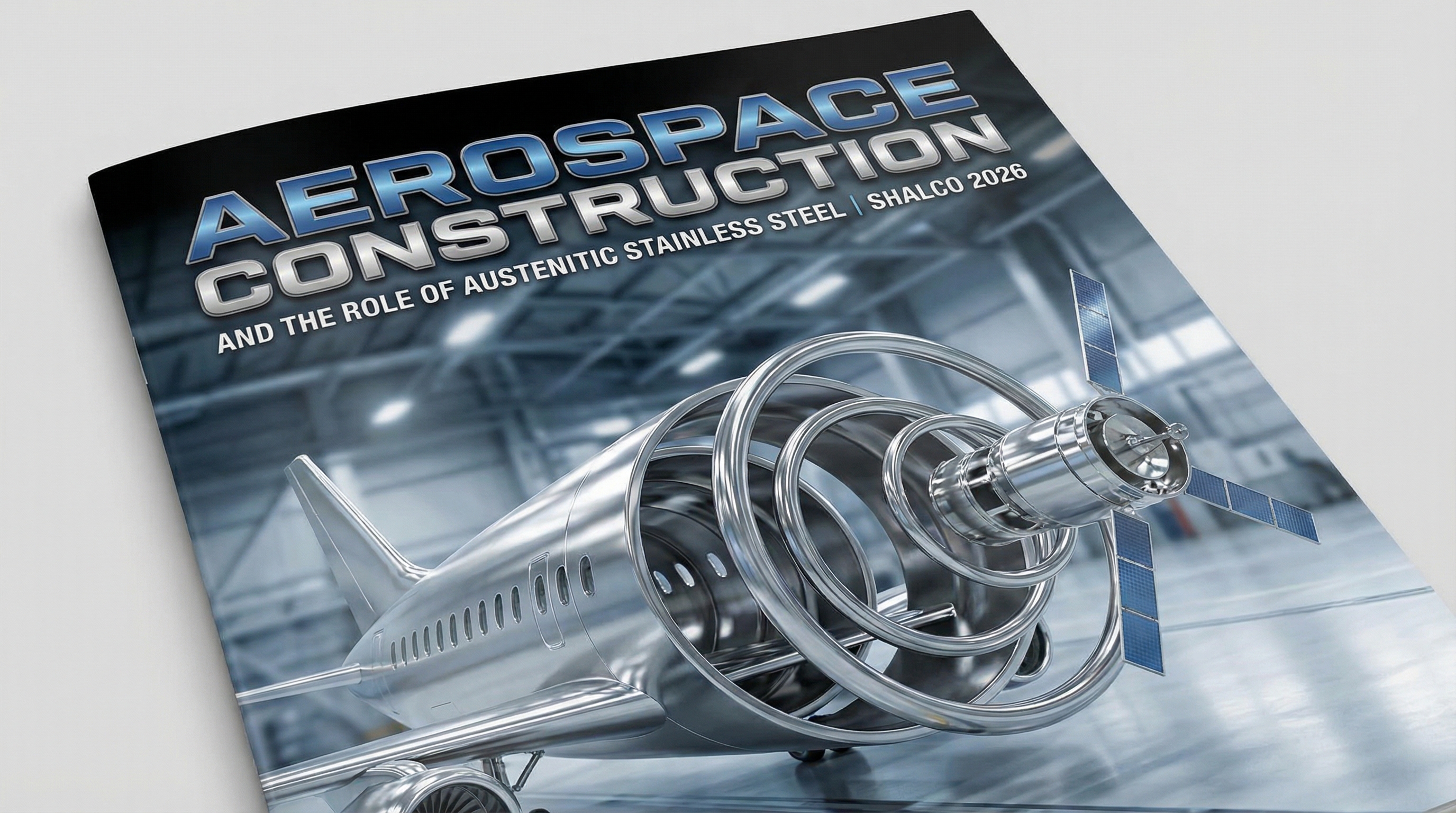
The aerospace industry represents the pinnacle of materials engineering, where performance requirements push materials to their absolute limits while demanding unwavering reliability. Every component that takes flight must endure extreme temperature variations, resist corrosion from atmospheric exposure, maintain structural integrity under immense stresses, and accomplish all this while minimizing weight. In this demanding environment, austenitic stainless steels have carved out critical roles that leverage their unique combination of properties. At Shalco, we understand that aerospace applications require not just high-quality materials but also exceptional traceability, consistency, and technical support. This comprehensive guide explores how austenitic stainless steels contribute to modern aerospace construction, which grades excel in specific applications, and why these materials remain indispensable despite the aerospace industry's continual pursuit of advanced composites and exotic alloys.
The Demanding World of Aerospace Materials
Understanding austenitic stainless steel's role in aerospace requires appreciating the extraordinary demands placed on aircraft and spacecraft materials. Unlike ground-based applications where failure might cause inconvenience or economic loss, aerospace failures can result in catastrophic consequences, making material reliability absolutely paramount.
Extreme temperature cycling represents one of the most challenging aspects of aerospace service. Aircraft structures experience temperatures ranging from -55°C at cruise altitude to over 150°C in certain engine compartments and hot zones. Supersonic and hypersonic vehicles face even more extreme thermal environments, with leading edges and engine components experiencing temperatures exceeding 600°C. Materials must maintain mechanical properties, dimensional stability, and corrosion resistance across these temperature extremes while enduring thousands of thermal cycles over operational lifetimes.
Weight optimization drives every material selection decision in aerospace. The fundamental economics of flight dictate that every kilogram of structural weight reduces payload capacity or increases fuel consumption. Engineers constantly balance strength requirements against weight penalties, seeking materials that deliver maximum performance per unit weight. This weight sensitivity explains why aerospace has pioneered advanced materials like titanium alloys, aluminum-lithium alloys, and carbon fiber composites. Within this context, austenitic stainless steels must justify their density of approximately 8.0 g/cm³ through superior properties that lighter materials cannot match.
Corrosion resistance remains critical despite the controlled environments within aircraft. Atmospheric moisture, salt exposure in coastal operations, de-icing chemicals, hydraulic fluids, fuel residues, and cleaning agents all contribute to corrosive conditions. Aircraft structures must maintain integrity through decades of service, often exceeding 30 years for commercial aircraft and military platforms. Materials that corrode prematurely compromise structural integrity and increase maintenance burdens, making corrosion resistance a non-negotiable requirement for many applications.
Mechanical property requirements in aerospace often exceed those in other industries. High strength-to-weight ratios, excellent fatigue resistance for structures experiencing millions of loading cycles, superior toughness to prevent catastrophic failure, and maintained properties across temperature ranges all factor into material selection. Certifications and stringent testing verify that materials consistently meet specifications, with traceability requirements ensuring every component's material history is documented from melt through fabrication.
Shalco specializes in providing aerospace-grade austenitic stainless steels with complete traceability, certifications meeting aerospace standards, and technical support that helps engineers optimize material selection for their specific applications.
Fundamental Properties of Austenitic Stainless Steels for Aerospace
Austenitic stainless steels, characterized by their face-centered cubic crystal structure stabilized by nickel and nitrogen, offer a distinctive property profile that makes them valuable in aerospace despite their relatively high density.
Exceptional Corrosion Resistance
The chromium-rich passive oxide film that forms on austenitic stainless steel surfaces provides outstanding resistance to atmospheric corrosion, oxidation at elevated temperatures, and chemical attack from fluids commonly encountered in aerospace service. This inherent corrosion resistance eliminates or reduces the need for protective coatings, simplifying manufacturing and reducing maintenance requirements. In applications where coatings might wear, crack, or degrade, the self-healing nature of the passive film ensures continued protection.
Cryogenic Toughness
Unlike many structural alloys that become brittle at low temperatures, austenitic stainless steels maintain excellent toughness down to cryogenic temperatures. This unique characteristic makes them ideal for liquid oxygen (LOX) systems, liquid hydrogen tanks, cryogenic fuel lines, and other aerospace applications involving ultra-low temperatures. Where aluminum alloys and carbon steels would fail catastrophically, austenitic grades continue performing reliably.
High-Temperature Stability
While not approaching the temperature capabilities of nickel-base superalloys, austenitic stainless steels maintain useful strength and oxidation resistance to approximately 800-900°C depending on grade. This capability, combined with their corrosion resistance and reasonable cost, makes them suitable for numerous aerospace applications in moderately elevated temperature zones where superalloys would be unnecessarily expensive.
Non-Magnetic Properties
Most austenitic stainless steels are non-magnetic in the annealed condition, a critical property for applications near sensitive instruments, magnetic sensors, and navigation equipment. This characteristic prevents interference with compasses, magnetometers, and other magnetic field-sensitive devices, making austenitic grades preferred choices for instrument mounting hardware and components near avionic systems.
Excellent Fabricability
Austenitic stainless steels offer superior formability, weldability, and machinability compared to many high-strength aerospace alloys. They can be formed into complex shapes without cracking, welded using conventional processes without special precautions, and machined with standard tooling. This fabricability reduces manufacturing costs and enables design flexibility, important considerations in aerospace where complex geometries are common.
Work Hardening Characteristics
Austenitic stainless steels strain harden significantly during cold working, allowing strength to be increased through controlled deformation. This enables tailoring properties to specific applications through cold rolling, drawing, or forming operations. Spring-temper austenitic stainless steel products achieve strength levels approaching those of precipitation-hardened alloys while maintaining excellent corrosion resistance.
Primary Austenitic Grades in Aerospace Applications
Several austenitic stainless steel grades have become standard specifications in aerospace construction, each offering specific advantages for particular applications.
Grade 304/304L (UNS S30400/S30403)
Type 304, containing approximately 18% chromium and 8% nickel, represents the most widely used austenitic stainless steel across all industries, including aerospace. Its balance of properties, availability, and cost-effectiveness make it suitable for numerous non-critical aerospace applications. The low-carbon variant 304L offers improved weldability and is preferred for welded constructions.
Aerospace applications for 304/304L include fasteners and hardware in non-critical locations, brackets and support structures in protected environments, instrument mounting components, interior cabin fixtures and trim, and galley equipment. While not specified for primary structures or critical flight systems, 304/304L serves reliably in applications where its properties are adequate and cost considerations favor its use. Shalco supplies 304/304L in aerospace quality with appropriate certifications for these applications.
Grade 321 (UNS S32100)
Type 321 represents a stabilized modification of 304 with titanium additions (minimum 5 times carbon content) that prevent chromium carbide precipitation during welding or elevated temperature exposure. This stabilization maintains corrosion resistance in heat-affected zones and prevents intergranular attack, critical for aerospace applications involving welding or service temperatures between 400-900°C.
Applications include aircraft exhaust systems, engine mount components, jet engine afterburner parts, high-temperature ducting and tubing, and manifolds exposed to elevated temperatures. The combination of temperature capability, corrosion resistance, and weldability makes 321 particularly valuable in engine compartments and exhaust systems where temperatures exceed the capabilities of unstabilized grades. Shalco frequently recommends 321 for aerospace customers dealing with elevated temperature applications requiring welding.
Grade 347 (UNS S34700)
Type 347 achieves stabilization through niobium (columbium) additions rather than titanium, providing similar benefits to 321 with slightly superior creep strength at elevated temperatures. The niobium carbides formed are more stable than titanium carbides, offering better long-term performance in sustained high-temperature service.
Aerospace uses include jet engine components requiring stabilization, high-temperature exhaust systems, afterburner parts, and applications where sustained temperatures exceed 500°C. Grade 347 costs slightly more than 321 but justifies this premium in applications where its superior high-temperature stability provides performance advantages. Shalco maintains inventory of 347 for aerospace customers with critical high-temperature requirements.
Grade 316/316L (UNS S31600/S31603)
Type 316, with molybdenum additions of 2-3%, offers superior corrosion resistance compared to 304, particularly in chloride-containing environments. This enhanced resistance makes 316/316L the preferred choice for marine aircraft, coastal operations, and applications involving exposure to de-icing chemicals or salt spray. The low-carbon 316L variant dominates aerospace specifications due to superior weldability.
Applications include components on marine patrol aircraft and helicopters, structures on carrier-based naval aircraft, fasteners and hardware in corrosive environments, hydraulic system components, and fuel system parts. The material's resistance to pitting and crevice corrosion in chloride environments justifies its higher cost in applications where 304 would corrode prematurely. Shalco provides 316L certified to aerospace specifications for these demanding applications.
Grade A-286 (UNS S66286)
While technically a precipitation-hardening iron-nickel-chromium alloy rather than a standard austenitic stainless steel, A-286 deserves mention due to its importance in aerospace. Through aging heat treatment, A-286 achieves tensile strengths exceeding 1000 MPa while maintaining useful properties to 650°C and good corrosion resistance.
Critical aerospace applications include turbine engine bolts and fasteners, high-strength structural components in elevated temperature zones, afterburner parts, and exhaust systems. A-286 represents a bridge between standard austenitic grades and nickel-base superalloys, offering dramatically higher strength than conventional stainless steels at a fraction of superalloy costs. Shalco supplies A-286 in various forms with complete aerospace traceability for customers requiring this high-performance material.
Critical Aerospace Applications
Examining specific application areas illustrates how austenitic stainless steels contribute to aerospace systems.
Aircraft Structural Components
While primary aircraft structures predominantly use aluminum alloys, titanium, and composites for weight optimization, austenitic stainless steels serve in secondary structures and specialized locations. Floor beams and support structures in galleys and lavatories, cargo area fittings and tie-down points, access panels and inspection covers, and mounting brackets for equipment all utilize stainless steel where corrosion resistance and durability outweigh weight considerations. The long service life and minimal maintenance requirements of stainless components often justify their weight penalty compared to aluminum alternatives requiring protective finishes and more frequent inspection.
Fastener Systems
Fasteners represent perhaps the largest volume application of austenitic stainless steels in aerospace. Bolts, screws, nuts, washers, and rivets in stainless steel provide corrosion resistance, temperature capability, and magnetic neutrality that make them preferred choices for many applications. Different grades are specified based on environmental exposure and temperature requirements, with 304/304L for general applications, 316L for corrosive environments, 321 or 347 for elevated temperatures, and A-286 for high-strength critical applications.
The aerospace fastener industry maintains rigorous quality standards, and Shalco supplies materials meeting specifications such as AMS 5640 (304), AMS 5647 (316L), and others that define composition, mechanical properties, and quality requirements for aerospace fastener production.
Fuel and Hydraulic Systems
Austenitic stainless steels serve extensively in fuel and hydraulic systems throughout aircraft. Tubing for fuel lines and hydraulic lines, fittings and connectors, valves and actuator components, and filters and strainers all utilize grades like 304L or 321 depending on temperatures and fluids involved. The corrosion resistance prevents internal degradation from fuel or hydraulic fluid exposure, while the material's strength supports high-pressure operation.
Flexible stainless steel hoses with corrugated inner tubes and braided outer sheaths connect components experiencing relative movement, providing leak-free fluid transfer with excellent vibration resistance. These hoses have become standard in aerospace hydraulic and fuel systems, and Shalco provides materials for hose manufacturers serving the aerospace industry.
Exhaust Systems and High-Temperature Components
Aircraft exhaust systems, operating at temperatures typically between 400-700°C for auxiliary power units and ranging even higher for engine exhaust components, rely heavily on austenitic grades 321 and 347. Exhaust stacks and tailpipes, manifolds and ducting, heat shields protecting nearby components, and afterburner components all specify stabilized austenitic grades.
The combination of oxidation resistance, maintained mechanical properties at temperature, and good thermal fatigue resistance makes these materials well-suited for exhaust applications. While not matching the temperature capability of nickel-base superalloys used in hot sections of jet engines, austenitic stainless steels handle moderately elevated temperatures at a fraction of superalloy costs.
Cryogenic Systems
Rocket propulsion systems using liquid oxygen and liquid hydrogen depend on austenitic stainless steels for many components exposed to cryogenic temperatures. Storage tank materials, transfer lines and valves, pump components, and insulation support structures utilize grades like 304L or 316L that maintain toughness at temperatures approaching absolute zero.
The Apollo program extensively employed austenitic stainless steels in Saturn V rocket fuel systems, and modern launch vehicles continue this tradition. SpaceX's Falcon and Starship vehicles use stainless steel prominently, with the Starship vehicle featuring stainless steel tanks and structures taking advantage of the material's cryogenic properties and ease of fabrication.
Environmental Control Systems
Aircraft environmental control systems maintaining cabin pressure, temperature, and air quality use austenitic stainless steels in numerous components. Ducting and manifolds distributing air throughout the cabin, heat exchangers transferring thermal energy, filters removing contaminants, and valves controlling flow rates all employ stainless grades selected for their corrosion resistance, temperature capability, and long service life.
Galley and Lavatory Equipment
Aircraft galleys and lavatories universally employ austenitic stainless steel due to its hygiene, corrosion resistance, ease of cleaning, and aesthetic appeal. Sinks, countertops, equipment housings, waste system components, and water system parts all specify grades like 304 or 316L depending on specific requirements. The material's resistance to cleaning chemicals and moisture prevents corrosion issues that would plague carbon steel alternatives.
Manufacturing and Quality Considerations
Producing austenitic stainless steel components for aerospace demands exceptional attention to quality and traceability. Material certifications documenting chemistry, mechanical properties, and heat treatment provide the foundation for aerospace quality. Each batch must include certificates traceable to the original melt, with test results demonstrating compliance with aerospace specifications.
Heat treatment protocols ensure materials achieve specified properties. Solution annealing, typically performed at 1010-1120°C followed by rapid cooling, dissolves carbides and achieves proper microstructure. For stabilized grades like 321 and 347, stabilization treatments precipitate titanium or niobium carbides, preventing chromium carbide formation during subsequent service.
Non-destructive testing verifies material integrity. Ultrasonic inspection detects internal defects, liquid penetrant inspection reveals surface cracks, and radiographic examination identifies internal discontinuities. These inspections ensure materials are free from defects that could compromise performance.
Surface finish requirements in aerospace often exceed those in other industries. Smooth, clean surfaces reduce stress concentrations, minimize corrosion initiation sites, and meet aesthetic requirements. Electropolishing, passivation, and other surface treatments enhance corrosion resistance and appearance.
Shalco maintains quality systems aligned with aerospace requirements, providing materials with complete documentation, traceability, and certifications that meet customer specifications and regulatory requirements. Our understanding of aerospace quality standards ensures customers receive materials ready for incorporation into critical flight hardware.
Future Trends in Aerospace Stainless Steel Applications
The aerospace industry continues evolving, creating both challenges and opportunities for austenitic stainless steel applications.
Additive manufacturing enables complex geometries previously impossible to produce. 3D printing of austenitic stainless steels allows optimized structures with internal channels, lattice structures reducing weight while maintaining strength, and complex shapes consolidating multiple parts. This technology promises to expand austenitic stainless steel applications in aerospace through design possibilities unachievable with conventional manufacturing.
Hybrid structures combining stainless steel with composites, aluminum, and titanium leverage each material's strengths. Dissimilar material joining techniques enable structures optimized for local requirements, with stainless steel used where its properties are most advantageous. Shalco works with aerospace engineers to identify applications where austenitic stainless steels offer optimal solutions within hybrid designs.
Commercial space industry growth drives demand for cost-effective, reliable materials. Launch vehicles, satellites, space stations, and eventually spacecraft for space tourism will require materials balancing performance and economics. Austenitic stainless steels, with their combination of properties and relative affordability, are positioned to play expanded roles in commercial space applications.
Sustainable aviation initiatives prioritizing lifecycle environmental impacts favor materials like stainless steel that are fully recyclable and offer extended service lives. The aerospace industry's growing focus on sustainability aligns well with stainless steel's environmental profile, potentially expanding its applications even where weight penalties exist.
Conclusion
Austenitic stainless steels occupy critical niches in aerospace construction, providing unique combinations of corrosion resistance, cryogenic toughness, high-temperature capability, fabricability, and reliability that ensure their continued relevance despite ongoing materials innovation. From fasteners holding aircraft together to cryogenic tanks enabling space exploration, these versatile alloys contribute to the safety, reliability, and performance of aerospace systems. At Shalco, our commitment to quality, traceability, and technical support ensures aerospace customers receive materials meeting the exacting standards their applications demand. As aerospace technology advances into new frontiers—from hypersonic flight to commercial space travel—austenitic stainless steels will continue playing vital roles, their fundamental properties as relevant to tomorrow's aerospace challenges as they are to today's. Whether you're designing next-generation aircraft, developing launch vehicles, or maintaining existing fleets, Shalco's expertise in aerospace-grade austenitic stainless steels ensures you have the materials and technical support necessary for success in this most demanding industry.
