In industrial environments where temperatures routinely exceed 1000°C, where oxidizing atmospheres attack materials relentlessly, and where thermal cycling subjects components to extreme stresses, most conventional materials fail within months or even weeks. Furnace components, heat treating equipment, chemical processing reactors, and power generation systems all face these punishing high-temperature conditions that destroy ordinary metals through oxidation, scaling, creep deformation, and thermal fatigue. Engineers designing equipment for these extreme environments require materials that don't simply survive high heat—they must maintain structural integrity, resist corrosion, and provide reliable long-term performance where failure means catastrophic consequences.
Among the specialized alloys engineered for extreme high-temperature service, Alloy 601 (UNS N06601) stands as a proven performer combining exceptional oxidation resistance, outstanding high-temperature strength, remarkable resistance to carburization and other forms of high-temperature attack, and proven reliability across decades of demanding industrial applications. This nickel-chromium-aluminum-iron alloy has become the material of choice for applications where conventional stainless steels fail within hours and where even some other superalloys cannot match its comprehensive high-temperature performance.
Understanding Alloy 601: Composition and Metallurgy
Chemical Composition: Engineered for Extreme Heat
Alloy 601's exceptional high-temperature performance stems from its carefully optimized chemical composition where each element serves critical metallurgical purposes:
Nickel (58-63%): As the base element, nickel provides the face-centered cubic (FCC) austenitic structure that maintains ductility and toughness at both cryogenic and elevated temperatures. High nickel content ensures the alloy remains austenitic rather than transforming to brittle structures at elevated temperatures, while providing resistance to reducing atmospheres and excellent thermal stability.
Chromium (21-25%): The primary element providing oxidation and corrosion resistance. At these concentration levels, chromium forms highly protective chromium oxide (Cr₂O₃) scales that remain adherent and protective at temperatures exceeding 1100°C. This chromium content significantly exceeds that of austenitic stainless steels, extending the temperature ceiling for reliable operation.
Aluminum (1.0-1.7%): A critical element distinguishing Alloy 601 from many other nickel-based alloys. Aluminum forms aluminum oxide (Al₂O₃) within the protective oxide scale, dramatically enhancing oxidation resistance. The aluminum content is optimized—sufficient to provide exceptional protection but controlled to avoid forming excessive internal oxidation or brittle aluminum-rich phases that would compromise mechanical properties.
Iron (14% nominal, balance): Reduces cost compared to pure nickel-chromium alloys while contributing to solid solution strengthening and maintaining adequate ductility. The iron content distinguishes Alloy 601 from higher-nickel alloys, positioning it as a cost-effective solution for many high-temperature applications.
Carbon (0.10% maximum): Controlled at low levels to prevent excessive carbide precipitation that could embrittle the alloy or reduce corrosion resistance, while maintaining sufficient carbon for some strengthening through carbide formation.
Manganese (1.0% maximum): Acts as a deoxidizer during melting and provides minor solid solution strengthening.
Silicon (0.50% maximum): Contributes to oxidation resistance and acts as a deoxidizer, though controlled to avoid excessive levels that could form brittle silicide phases.
This composition represents decades of metallurgical refinement balancing oxidation resistance, high-temperature strength, resistance to various forms of attack, fabricability, and cost-effectiveness into a single alloy suitable for diverse demanding applications.
Microstructure and High-Temperature Behavior
Alloy 601's microstructure consists of a nickel-based austenitic matrix with dispersed carbide particles that provide strengthening without excessive embrittlement. Unlike precipitation-hardened superalloys, Alloy 601 derives its properties primarily from solid solution strengthening and its protective oxide scale rather than from complex precipitation sequences requiring precise heat treatment.
Oxide Scale Formation: When exposed to high temperatures in oxidizing atmospheres, Alloy 601 develops a complex protective scale consisting of outer chromium oxide (Cr₂O₃) layers providing the primary protective barrier, inner aluminum oxide (Al₂O₃) zones that dramatically slow further oxidation, and chromium-aluminum mixed oxide regions that enhance scale adherence and protective characteristics.
This multi-layered oxide scale grows slowly and remains adherent even under thermal cycling, providing long-term protection that simpler oxide scales on conventional alloys cannot match.
Why High-Temperature Applications Demand Alloy 601
1. Exceptional Oxidation Resistance
The most compelling reason engineers specify Alloy 601 is its outstanding resistance to oxidation at extreme temperatures.
Temperature Capability: Alloy 601 maintains excellent oxidation resistance in continuous service to approximately 1200°C (2200°F), with intermittent excursions to 1250°C possible. This temperature capability far exceeds austenitic stainless steels like 304 or 316 (limited to ~900°C for oxidation resistance) and extends beyond many other high-temperature alloys.
Scale Adherence: The protective oxide scale on Alloy 601 remains adherent rather than spalling off even under severe thermal cycling. Many materials form oxide scales that crack and spall during heating and cooling cycles, exposing fresh metal to continued attack. Alloy 601's aluminum-enhanced oxide scale maintains integrity through hundreds or thousands of thermal cycles, providing long-term protection without progressive metal loss.
Slow Oxidation Kinetics: Even at extreme temperatures, Alloy 601 oxidizes slowly. Metal loss rates remain acceptably low even after years of continuous high-temperature exposure, enabling component design with minimal corrosion allowances and ensuring dimensional stability throughout long service lives.
This oxidation resistance makes Alloy 601 the material of choice for furnace components including muffles, retorts, and heating elements, heat treating baskets and fixtures, industrial heating elements and resistance wire, and high-temperature exhaust systems.
2. Outstanding Resistance to Carburization
Many high-temperature processes involve carbon-containing atmospheres that cause carburization—carbon diffusing into metals, forming brittle carbides that destroy ductility and cause premature failure. Alloy 601 provides exceptional resistance to carburization that most other materials cannot match.
Protective Oxide Barrier: The adherent chromium-aluminum oxide scale on Alloy 601 acts as an effective barrier preventing carbon penetration into the underlying metal. While chromium oxide alone provides some carburization resistance, the aluminum oxide contribution dramatically enhances protection.
Applications in Carburizing Environments: This carburization resistance makes Alloy 601 essential for heat treating equipment including carburizing furnace components, retorts for pack carburizing, fixtures holding parts during carbon-enrichment processes, and petrochemical reforming reactors operating in hydrogen-hydrocarbon atmospheres that would rapidly carburize lesser materials.
In environments where austenitic stainless steels carburize and fail within months, Alloy 601 components routinely provide 5-10 years of reliable service—a dramatic difference in equipment lifecycle costs.
3. Resistance to Nitriding and Nitridation
Similar to carburization, nitriding involves nitrogen penetration forming hard, brittle nitride phases that embrittle materials. Some high-temperature processes employ nitrogen or ammonia atmospheres that cause rapid nitriding in susceptible alloys.
Alloy 601's protective oxide scale and optimized composition provide good resistance to nitriding, though not as exceptional as its carburization resistance. For applications involving nitrogen-containing atmospheres at elevated temperatures—such as nitrocarburizing furnaces, ammonia crackers for hydrogen production, and certain chemical synthesis reactors—Alloy 601 offers superior performance compared to conventional stainless steels.
4. High-Temperature Strength and Creep Resistance
While Alloy 601 is not the strongest superalloy at elevated temperatures (precipitation-hardened alloys like Inconel 718 or Waspaloy provide higher strength), it offers excellent strength-to-cost ratio for many applications.
Stress-Rupture Properties: Alloy 601 maintains useful strength to approximately 1000°C under moderate stress levels, providing adequate structural integrity for furnace components, heat exchanger tubes, and process equipment operating at these temperatures.
Creep Resistance: Time-dependent deformation under sustained high-temperature loading (creep) limits material service life. Alloy 601's solid solution strengthening and carbide dispersion provide good creep resistance for its composition class, enabling reliable long-term performance under moderate stress at elevated temperatures.
Thermal Fatigue Resistance: Equipment experiencing repeated heating and cooling develops thermal stresses from expansion and contraction. Alloy 601's combination of ductility, strength, and oxidation resistance provides excellent thermal fatigue life—components survive thousands of thermal cycles without cracking.
5. Resistance to Molten Salts and Slags
Some high-temperature processes involve molten salts, fluxes, or slags that attack metals through complex corrosion mechanisms. Alloy 601 provides good resistance to many molten media including certain molten salts used in heat treating, salt bath quenching media, and fluxes encountered in metallurgical processing.
While no material provides universal resistance to all molten media, Alloy 601's nickel-chromium base and protective oxide scale offer better resistance than stainless steels, making it viable for applications involving intermittent molten salt exposure.
Critical Industrial Applications for Alloy 601
Heat Treating and Thermal Processing
Furnace Components: Alloy 601 is extensively used throughout heat treating industries for muffles and retorts containing controlled atmospheres, radiant heating tubes in high-temperature furnaces, conveyor belts for continuous furnaces, furnace fixtures and supports, and door frames and seals exposed to high temperatures.
These components must withstand continuous high-temperature exposure while maintaining dimensional stability. Alloy 601's oxidation resistance and creep strength ensure reliable long-term performance where replacement costs and production disruptions make material reliability essential.
Heat Treating Baskets and Fixtures: Parts being heat treated must be supported on fixtures that withstand the same temperatures without distorting or contaminating the parts. Alloy 601 baskets, trays, and fixtures provide the required temperature capability, resistance to carburizing atmospheres when applicable, dimensional stability preventing warping, and longevity reducing replacement frequency.
Chemical and Petrochemical Processing
Catalyst Regeneration: Fluid catalytic cracking (FCC) units in refineries operate at temperatures where catalysts must be periodically regenerated by burning off accumulated carbon deposits. Regeneration occurs at temperatures exceeding 700°C in oxidizing atmospheres. Alloy 601 serves in regenerator cyclones and piping, expansion joints accommodating thermal growth, and internal components exposed to highest temperatures.
Reforming and Cracking: Hydrocarbon reforming processes that rearrange molecular structures or crack large molecules into smaller ones occur at elevated temperatures. Alloy 601 finds use in reformer tubes and piping, reactor internal components, and transfer line piping in ethylene crackers.
Nitric Acid Production: The Ostwald process for nitric acid manufacture involves catalytic oxidation of ammonia at temperatures around 800-900°C. Alloy 601 provides materials for catalytic converter grids supporting platinum-rhodium catalysts, expansion joints in hot gas piping, and high-temperature ducting.
Power Generation
Gas Turbine Components: While rotating components in gas turbines require higher-strength precipitation-hardened superalloys, stationary components use Alloy 601 including combustor cans and transition pieces, exhaust ducts and manifolds, heat shields protecting structural components, and fasteners in high-temperature zones.
Waste Heat Recovery: Systems recovering waste heat from exhaust gases operate at elevated temperatures where Alloy 601 provides heat exchanger tubing, headers and manifolds, and expansion bellows.
Industrial Heating and Furnaces
Heating Elements: Alloy 601 wire and strip serve as resistance heating elements in industrial and laboratory furnaces, providing uniform heating to temperatures exceeding 1100°C, long service life reducing maintenance, and resistance to oxidation and embrittlement.
Radiant Tubes: Indirect-fired furnaces use radiant tubes that are heated externally and radiate heat into the furnace. Alloy 601 radiant tubes withstand external combustion gas exposure, internal atmosphere that may be carburizing or nitriding, and frequent thermal cycling.
Kilns and Calciners: Rotary kilns, calcining furnaces, and similar equipment for processing minerals, cement, or chemicals operate at high temperatures. Alloy 601 components include kiln shells and supports, internal baffles and flights, and sealing components.
Aerospace and Defense
Jet Engine Components: Non-rotating gas turbine components in military and commercial aircraft engines use Alloy 601 for afterburner components, exhaust nozzles and ducts, engine cowling and heat shields, and fasteners in hot sections.
Rocket Motor Components: Solid rocket motors generate extreme temperatures during firing. Alloy 601 provides materials for nozzle throat inserts (in some designs), support structures for insulation, and igniter components.
Fabrication and Manufacturing Considerations
Forming and Machining
Cold Working: Alloy 601 can be cold-formed using conventional equipment, though it work-hardens moderately during deformation. Annealing between forming operations may be required for severe deformations. The alloy's ductility in annealed condition permits bending, rolling, and drawing operations producing tubes, sheets, and wire.
Hot Working: Hot forming at temperatures typically 1040-1200°C enables more extensive deformation with lower forces. Hot working is commonly employed in producing wrought products from cast or forged starting materials.
Machining: Alloy 601 machines more readily than many other nickel-based alloys, though it is more difficult than carbon steel or austenitic stainless steels. Proper machining requires sharp carbide or ceramic tooling, positive rake angles reducing forces, adequate coolant preventing heat buildup, and moderate speeds and feeds appropriate for nickel alloys.
Welding
Alloy 601 exhibits good weldability using common fusion welding processes including gas tungsten arc welding (GTAW/TIG) providing excellent control for critical welds, gas metal arc welding (GMAW/MIG) for production welding, shielded metal arc welding (SMAW) for field repairs, and resistance welding for sheet metal fabrication.
Welding Considerations: Successful welding requires matching filler metals (AWS ERNiCrFe-2 for Alloy 601), inert gas shielding (argon or helium) preventing contamination, controlled heat input avoiding excessive grain growth, and stress relief post-weld heat treatment for heavy sections or highly restrained joints.
Properly welded joints maintain base metal oxidation resistance and high-temperature properties, enabling complex fabrications from Alloy 601.
Heat Treatment and Property Optimization
Alloy 601 is typically used in the solution-annealed condition rather than requiring precipitation hardening heat treatments. The standard heat treatment is:
Solution Annealing: Heat to 1040-1150°C (1900-2100°F), hold for sufficient time to dissolve carbides and homogenize the structure, followed by rapid cooling (typically water quenching or rapid air cooling) to retain elements in solution and achieve optimal grain structure.
This heat treatment produces optimal ductility, corrosion resistance, and high-temperature oxidation resistance. No subsequent aging treatment is required or beneficial for Alloy 601—in fact, prolonged exposure to intermediate temperatures (650-850°C) can precipitate carbides that reduce ductility without providing compensating strength increases.
Alternatives and Material Selection Guidance
Compared to Austenitic Stainless Steels (304, 310, 316)
Advantages of Alloy 601:
- Superior oxidation resistance at temperatures above 900°C
- Exceptional carburization resistance
- Better high-temperature strength and creep resistance
- Longer service life in extreme environments
When Stainless Steel Suffices: Applications below 800°C without severe carburizing atmospheres where the cost premium of Alloy 601 cannot be justified.
Compared to Other Nickel-Based Alloys
Versus Alloy 600: Alloy 600 (Ni-Cr-Fe without aluminum) provides good oxidation resistance but significantly inferior carburization resistance compared to Alloy 601. For carburizing environments, Alloy 601 clearly prevails.
Versus Alloy 625: Alloy 625 offers better aqueous corrosion resistance and higher strength but costs significantly more and provides no advantage for high-temperature oxidation or carburization resistance—the primary reasons for selecting Alloy 601.
Versus Alloy 800/800H/800HT: These iron-nickel-chromium alloys compete with Alloy 601 in some applications. Alloy 601 generally provides better carburization resistance, while Alloy 800H/800HT may offer better creep strength for highly stressed components.
Quality Assurance and Specifications
Alloy 601 for critical high-temperature applications should meet rigorous specifications:
ASTM Standards:
- ASTM B166: Rod, bar, and wire
- ASTM B167: Seamless pipe and tube
- ASTM B168: Plate, sheet, and strip
- ASTM B564: Forgings
ASME Standards: ASME SB-specifications corresponding to ASTM standards for pressure vessel and boiler applications.
Quality Requirements: Chemical composition verification via spectrographic analysis, mechanical property testing confirming strength and ductility, grain size control ensuring optimal properties, surface quality inspection, and complete traceability documentation.
Conclusion: Proven Performance at Temperature Extremes
Alloy 601's decades of proven performance in the world's most demanding high-temperature applications reflects genuine metallurgical advantages rather than marketing claims. Its exceptional oxidation resistance maintaining protective scales to 1200°C, outstanding carburization resistance enabling service in carbon-rich atmospheres, good high-temperature strength and creep resistance, excellent thermal fatigue resistance, and cost-effectiveness compared to more exotic superalloys create a property combination ideally suited for extreme heat applications.
From heat treating furnaces to chemical reactors, from power generation equipment to aerospace components, Alloy 601 enables reliable operation at temperatures where ordinary materials fail catastrophically. As industries continue pushing temperature boundaries seeking improved efficiency and performance, Alloy 601's role as a proven high-temperature workhorse ensures its continued importance.
For engineers designing equipment for extreme high-temperature service, Alloy 601 represents not merely another material option but a proven solution with decades of field validation demonstrating that when high heat threatens to destroy equipment, Alloy 601 delivers the reliable performance that keeps critical systems operating safely and efficiently.
Engineering reliability at high heat isn't just a tagline—it's the fundamental value proposition that has made Alloy 601 the trusted choice for extreme-temperature applications worldwide. Where others fail, Alloy 601 performs.
Why Specialized Alloys Are Essential for Chlorine and Fluorine Processing create a 1500 words of content and the shalco
11:30 PM
Why Specialized Alloys Are Essential for Chlorine and Fluorine Processing
Introduction: The Halogen Challenge
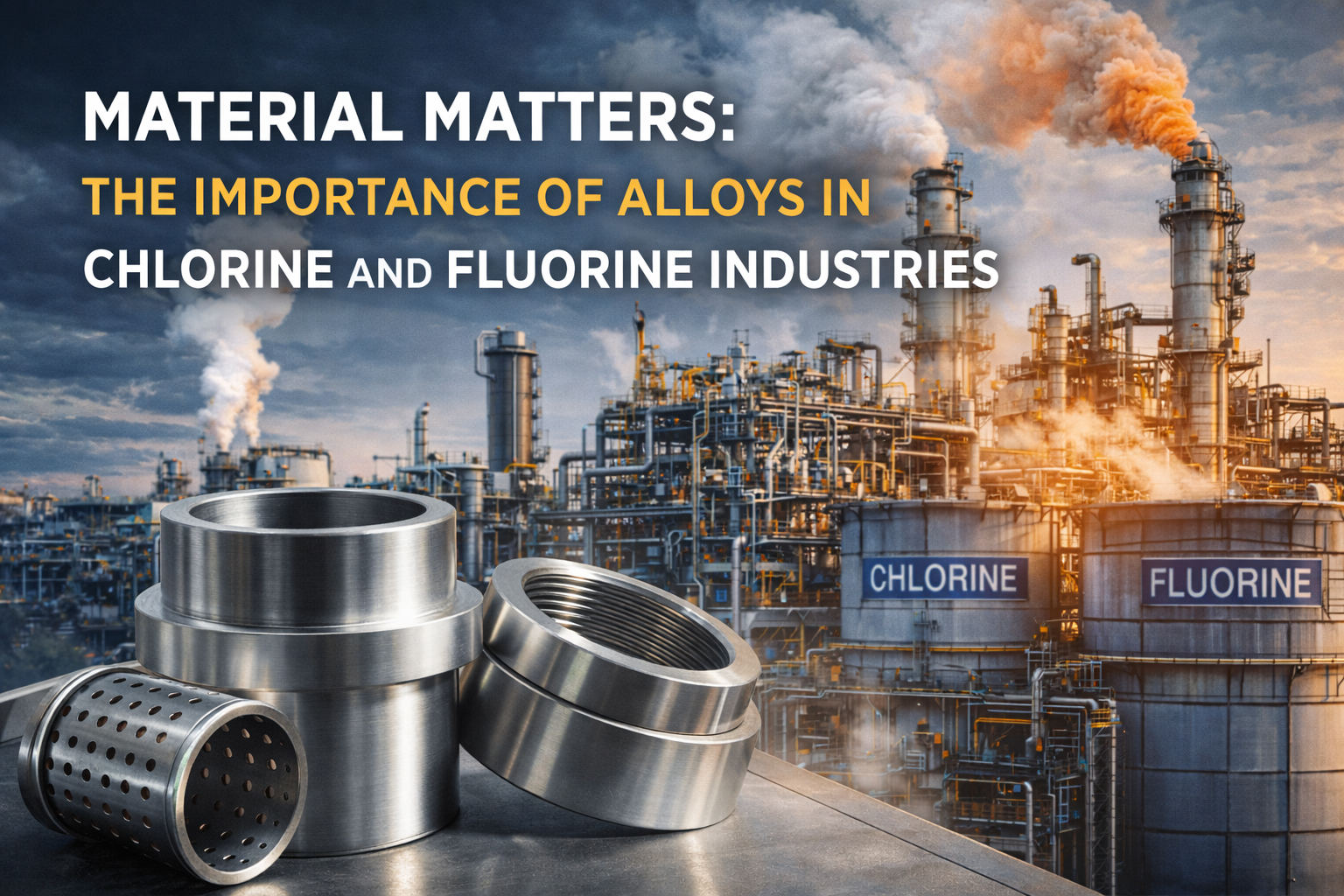
Among the most chemically aggressive elements encountered in industrial processing, chlorine and fluorine stand in a class apart. These halogens attack virtually all materials with an intensity and speed that can transform robust equipment into perforated scrap within days or weeks if inappropriate materials are selected. Chlorine processing facilities—producing chlorine gas, hydrochloric acid, or chlorinated compounds—and fluorine operations manufacturing fluoropolymers, refrigerants, or fluorochemicals represent some of the most demanding environments in chemical manufacturing, where material selection isn't merely an engineering consideration but the fundamental determinant of safety, reliability, and economic viability.
At Shalco, three decades of supplying materials to halogen processing facilities have demonstrated repeatedly that conventional materials fail catastrophically in these environments, that half-measures in material selection lead to half-life equipment, and that only properly specified specialized alloys provide the corrosion resistance, mechanical integrity, and long-term reliability these aggressive processes demand. This comprehensive examination explores why chlorine and fluorine are so uniquely corrosive, what makes specialized alloys essential rather than optional, and how Shalco's expertise in supplying and supporting these critical materials ensures customer success in the world's most challenging chemical environments.
Understanding Halogen Corrosivity: Why Ordinary Materials Fail
The Chemistry of Aggressive Attack
Chlorine's Corrosive Mechanisms: Chlorine gas (Cl₂) and chlorine-containing compounds attack metals through multiple simultaneous mechanisms. Dry chlorine gas oxidizes most metals, forming metal chlorides that are often volatile at elevated temperatures, preventing protective scale formation. The presence of moisture dramatically accelerates attack—even trace moisture combines with chlorine forming hydrochloric acid that rapidly corrodes most metals. Chlorine in aqueous solutions (hypochlorous acid, hypochlorite) creates aggressive oxidizing conditions attacking passive films on stainless steels.
Fluorine's Extreme Reactivity: Fluorine represents the most electronegative and reactive element, attacking virtually all materials with extraordinary vigor. Fluorine gas forms metal fluorides that often provide poor corrosion protection, leading to rapid metal wastage. Hydrofluoric acid (HF), while less reactive than fluorine gas, presents unique challenges—it attacks silica-based materials including glass and concrete, penetrates and destroys oxide protective films on metals, and causes both general corrosion and localized pitting even on corrosion-resistant alloys.
Synergistic Effects: Many halogen processes involve not just pure chlorine or fluorine but complex mixtures including water, acids, oxidizers, organic compounds, and elevated temperatures. These combinations create synergistic corrosion where total attack exceeds what individual components would cause, challenging materials in ways that simple laboratory tests cannot replicate.
Why Conventional Materials Fail
Carbon Steel: Chlorine and fluorine attack carbon steel so rapidly that it's essentially useless—dry chlorine gas at room temperature perforates carbon steel piping within days, and wet chlorine or HF cause even faster failure. The iron chlorides and fluorides formed provide no protective value.
Standard Stainless Steels (304, 316): While these alloys resist many corrosive environments, chlorine and fluorine rapidly breach their passive films. Pitting and crevice corrosion initiate within hours to days, stress corrosion cracking occurs under even moderate tensile stress, and general corrosion rates render equipment service life unacceptably short. Shalco has witnessed numerous catastrophic failures where standard stainless steels were inappropriately specified for halogen service—perforated heat exchangers, cracked reactors, and dissolved piping systems costing millions in emergency replacements and lost production.
Common Nickel Alloys: Even corrosion-resistant nickel alloys like Alloy 600 or Alloy 625 may prove inadequate for severe halogen service, particularly at elevated temperatures or in the presence of moisture. While better than stainless steels, these alloys don't provide the comprehensive resistance that specialized halogen-resistant alloys deliver.
Specialized Alloys for Halogen Processing: The Essential Solutions
Nickel-Based Alloys: Primary Defense Against Halogens
Alloy C-276 (UNS N10276): Shalco's most frequently supplied material for severe halogen service, Alloy C-276 combines nickel-chromium-molybdenum-tungsten composition providing exceptional resistance to both oxidizing and reducing conditions, outstanding resistance to chlorine, chlorine dioxide, and hypochlorite, excellent resistance to hydrochloric acid across concentrations and temperatures, good resistance to hydrofluoric acid under many conditions, and resistance to stress corrosion cracking in chloride environments.
The high molybdenum (15-17%) and tungsten (3-4.5%) contents provide extraordinary resistance to localized corrosion modes—pitting and crevice corrosion—that destroy lesser alloys. Shalco supplies Alloy C-276 in all product forms including seamless pipe and tube for process piping and heat exchangers, welded pipe for large-diameter applications, plate for vessel fabrication, and fittings, flanges, and fasteners for complete corrosion-resistant systems.
Alloy C-22 (UNS N06022): An evolution of C-276 chemistry optimizing resistance to oxidizing media, Alloy C-22 provides enhanced resistance to chlorine, bromine, and other oxidizing halogens, excellent resistance to wet chlorine gas—one of the most aggressive conditions, outstanding resistance to pitting and crevice corrosion, and superior weldability compared to some other nickel alloys.
For chlorine production facilities, especially chlor-alkali plants using membrane or diaphragm cell technology, Shalco frequently recommends Alloy C-22 for applications involving wet chlorine gas, hypochlorite solutions, and chlorine dioxide. The alloy's resistance to oxidizing conditions makes it ideal for these demanding services.
Alloy 59 (UNS N06059): A premium nickel-chromium-molybdenum alloy offering exceptional resistance across the complete corrosivity spectrum from strongly oxidizing to reducing conditions, superior resistance to hydrofluoric acid, excellent resistance to chlorine and chlorinated compounds, and outstanding resistance to sulfuric acid and mixed acids often present in halogen processes.
While more expensive than C-276 or C-22, Alloy 59's superior performance in the most aggressive halogen environments justifies its cost for critical applications where failure consequences are severe.
Alloy B-3 (UNS N10675): For hydrochloric acid service—a common component in chlorine processing—Alloy B-3 provides superior performance. This nickel-molybdenum alloy offers exceptional resistance to hydrochloric acid across all concentrations and temperatures to boiling, resistance to chlorine-contaminated acids, and excellent resistance to pitting and stress corrosion cracking.
Shalco supplies Alloy B-3 for HCl processing equipment including reactors, distillation columns, heat exchangers, and piping systems where hydrochloric acid is the primary corrosive medium.
Titanium and Titanium Alloys: Oxidizing Halogen Service
Commercial Pure Titanium (Grades 1-4): Titanium forms an extremely protective titanium dioxide (TiO₂) passive film that provides exceptional resistance to oxidizing environments including wet chlorine gas (one of titanium's signature applications), hypochlorous acid and hypochlorite solutions, chlorine dioxide (common in pulp bleaching), and seawater containing residual chlorine.
However, titanium's Achilles heel is susceptibility to attack in reducing conditions or in the presence of fluoride ions above certain concentrations. Shalco's technical team carefully evaluates whether titanium is appropriate based on complete process chemistry—the presence of even small amounts of reducing agents or excessive fluoride can preclude titanium use.
Titanium Alloys (Grades 7, 11, 12): Palladium-containing titanium alloys (Grades 7 and 11) provide enhanced corrosion resistance in reducing conditions compared to pure titanium, extending titanium's application range into more complex environments. Shalco supplies these specialized grades for applications where pure titanium is marginal but nickel alloys are unnecessarily expensive.
Tantalum: The Ultimate Solution for Extreme Conditions
For the most extreme halogen service—high-temperature hydrofluoric acid, anhydrous hydrogen fluoride, and other conditions where even premium nickel alloys prove marginal—tantalum provides unmatched corrosion resistance. Tantalum is essentially immune to hydrofluoric acid at all concentrations and temperatures below its boiling point, resists all concentrations of hydrochloric acid, and provides exceptional resistance to chlorine and fluorine compounds.
The limitations are tantalum's high cost (typically 50-100 times more expensive than stainless steel), lower strength requiring thicker sections or reinforcement, and limited availability. Shalco assists customers in determining when tantalum's superior performance justifies its cost—typically in small, critical components where other materials simply cannot survive, such as reactor vessel linings, specialized heat exchanger tubes, and critical valves and instrumentation.
Application-Specific Material Selection
Chlor-Alkali Production
Chlor-alkali plants electrolyze brine producing chlorine, caustic soda (sodium hydroxide), and hydrogen. The process creates multiple aggressive environments requiring different specialized materials:
Wet Chlorine Service: Chlorine gas leaving electrolytic cells contains moisture creating extraordinarily corrosive conditions. Shalco supplies:
- Titanium for piping, heat exchangers, and drying equipment where oxidizing conditions prevail
- Alloy C-276 or C-22 for applications where temperature or contamination make titanium marginal
- Special attention to gasket materials and valve trim—components often overlooked but critical for system integrity
Brine Service: Concentrated sodium chloride solutions attack many materials through pitting corrosion. Duplex stainless steels (which Shalco also supplies) often suffice for ambient temperature brine, while titanium provides superior performance in hot brine applications.
Caustic Service: The sodium hydroxide produced requires different materials—nickel-based alloys for high-concentration, high-temperature caustic, or specialized stainless steels for milder conditions. Shalco's expertise across multiple alloy families enables complete system specification.
Hydrochloric Acid Production and Processing
Synthesizing or handling hydrochloric acid creates aggressive conditions varying with concentration and temperature:
Concentrated HCl (30-37%): Alloy B-3 provides optimal resistance, particularly at elevated temperatures. Shalco supplies complete systems including reactors, absorbers, storage tanks, and piping in Alloy B-3.
Dilute HCl: Lower concentrations may permit less expensive materials. Shalco's technical team recommends appropriate materials based on exact concentration, temperature, and allowable corrosion rates—sometimes duplex stainless steels or even certain austenitic grades suffice, saving substantial costs.
HCl Gas: Dry HCl gas is less corrosive than aqueous solutions, but moisture contamination causes severe attack. Material selection must account for worst-case moisture scenarios.
Fluoropolymer Production
Manufacturing Teflon® and related fluoropolymers involves handling hydrofluoric acid, fluorinated monomers, and aggressive fluorine-containing intermediates:
HF Service: Concentrated hydrofluoric acid and anhydrous HF require the most corrosion-resistant materials. Shalco supplies:
- Alloy C-276 for moderate temperature HF service
- Alloy 59 for more severe conditions
- Monel alloys (nickel-copper) for specific HF applications where their unique resistance profile matches requirements
- Tantalum for the most extreme conditions
Fluoromonomer Handling: Tetrafluoroethylene (TFE) and other fluorinated monomers require materials resisting both the fluorinated compounds and the HF often present. Nickel alloys dominate this service.
Chlorinated Organic Production
Manufacturing chlorinated solvents, pesticides, or other organic chlorine compounds creates unique corrosion challenges:
Dry Chlorine with Organics: While dry chlorine with dry organics is relatively non-corrosive, any moisture creates aggressive conditions. Shalco recommends materials assuming moisture contamination occurs—conservative but prudent given the catastrophic failure modes possible.
Chlorinated Hydrocarbon Mixtures: Complex mixtures of chlorinated organics with residual HCl, moisture, and various impurities challenge material selection. Shalco's experience with actual plant conditions—often more aggressive than theoretical process chemistry suggests—informs realistic recommendations preventing premature failures.
Fabrication and Installation Considerations
Welding Critical for Corrosion Resistance
Specialized halogen-resistant alloys require proper welding to maintain corrosion resistance:
Alloy C-276 Welding: Requires matching filler metal (ERNiCrMo-4), inert gas shielding preventing contamination, controlled heat input avoiding excessive grain growth and phase precipitation, and no post-weld heat treatment in most cases (which could precipitate harmful phases).
Titanium Welding: Demands exceptional cleanliness and shielding—atmospheric contamination during welding severely degrades corrosion resistance. Requires inert gas shielding of weld puddle, trailing shields protecting cooling weld, back-purging for full penetration welds, and absolutely clean surfaces free from oils or oxides.
Shalco provides welding procedure specifications, filler metal supply, and technical support ensuring customers' fabrication teams achieve welds maintaining base metal corrosion resistance.
System Design Considerations
Beyond material selection, proper system design prevents corrosion problems:
Avoiding Crevices: Crevice corrosion attacks even resistant alloys in halogen service. Design must minimize threaded connections, gasket crevices, and stagnant zones. Shalco recommends butt-welded construction wherever possible, full-penetration welds eliminating crevice potential, and careful gasket selection and surface finish at flanged joints.
Eliminating Galvanic Couples: Connecting dissimilar metals in halogen service accelerates corrosion of the less noble material. Complete systems should use consistent materials, or employ isolation techniques where different materials must connect.
Drainage and Moisture Control: Since moisture dramatically accelerates chlorine attack, design must ensure complete drainage, prevent condensation through temperature control or heating, and eliminate moisture ingress through proper sealing.
Shalco's Value Beyond Material Supply
Technical Consultation
Shalco doesn't merely sell specialized alloys—we provide engineering consultation including:
Process Chemistry Analysis: We work with customers to completely characterize their environments—not just primary reagents but also impurities, temperature variations, and upset conditions that might occur.
Material Selection Optimization: Rather than defaulting to the most expensive "safest" option, we identify optimal materials balancing performance and cost—sometimes premium alloys are essential, but often less expensive materials suffice with proper specification.
Failure Analysis: When corrosion problems occur, Shalco's technical team investigates root causes, determines whether material selection was appropriate, and recommends solutions preventing recurrence.
Quality Assurance
Halogen service demands uncompromising quality:
Material Verification: Every Shalco shipment includes positive material identification (PMI) testing confirming chemistry, complete mill test reports documenting composition and properties, and traceability to specific heats for quality investigations if needed.
Specialized Testing: For critical applications, we coordinate corrosion testing simulating service conditions, mechanical property testing confirming suitability, and third-party inspection providing independent verification.
Supply Chain Reliability
Specialized alloys often have limited availability and long lead times. Shalco's strategic inventory of common halogen-resistant materials—Alloy C-276 pipe, C-22 fittings, titanium plate—enables rapid response to customer needs. Our global sourcing network provides access to specialty materials from multiple mills, ensuring supply even when individual sources face constraints.
Conclusion: Investment in Safety and Reliability
The specialized alloys essential for chlorine and fluorine processing represent significant material cost premiums—Alloy C-276 typically costs 8-12 times more than stainless steel, titanium 4-6 times more, and tantalum 50-100 times more. These costs tempt some to economize through marginal material selections, hoping standard stainless steels might "last long enough" or that regular replacement schedules can accommodate premature failures.
Shalco's three decades of experience demonstrate unequivocally that this approach fails—not just technically but economically. The true costs of inappropriate material selection include emergency shutdowns and lost production, emergency replacement at premium pricing, safety incidents and potential injuries, environmental releases and regulatory consequences, and reputation damage from unreliable operations. These costs dwarf the incremental investment in proper materials.
When processing halogens, specialized corrosion-resistant alloys aren't luxuries—they're essential engineering requirements determined by chemistry, not accounting preferences. Shalco's commitment is ensuring customers understand why these materials are necessary, supplying genuine quality materials with complete documentation, providing technical support optimizing specifications, and standing behind products with comprehensive service.
Processing chlorine or fluorine? Contact Shalco's technical team for material selection consultation, competitive pricing on specialized alloys, and the expertise that comes from three decades serving the chemical processing industry. When ordinary materials fail, specialized alloys perform—and Shalco delivers the materials and knowledge ensuring your success in chemistry's most challenging environments.