
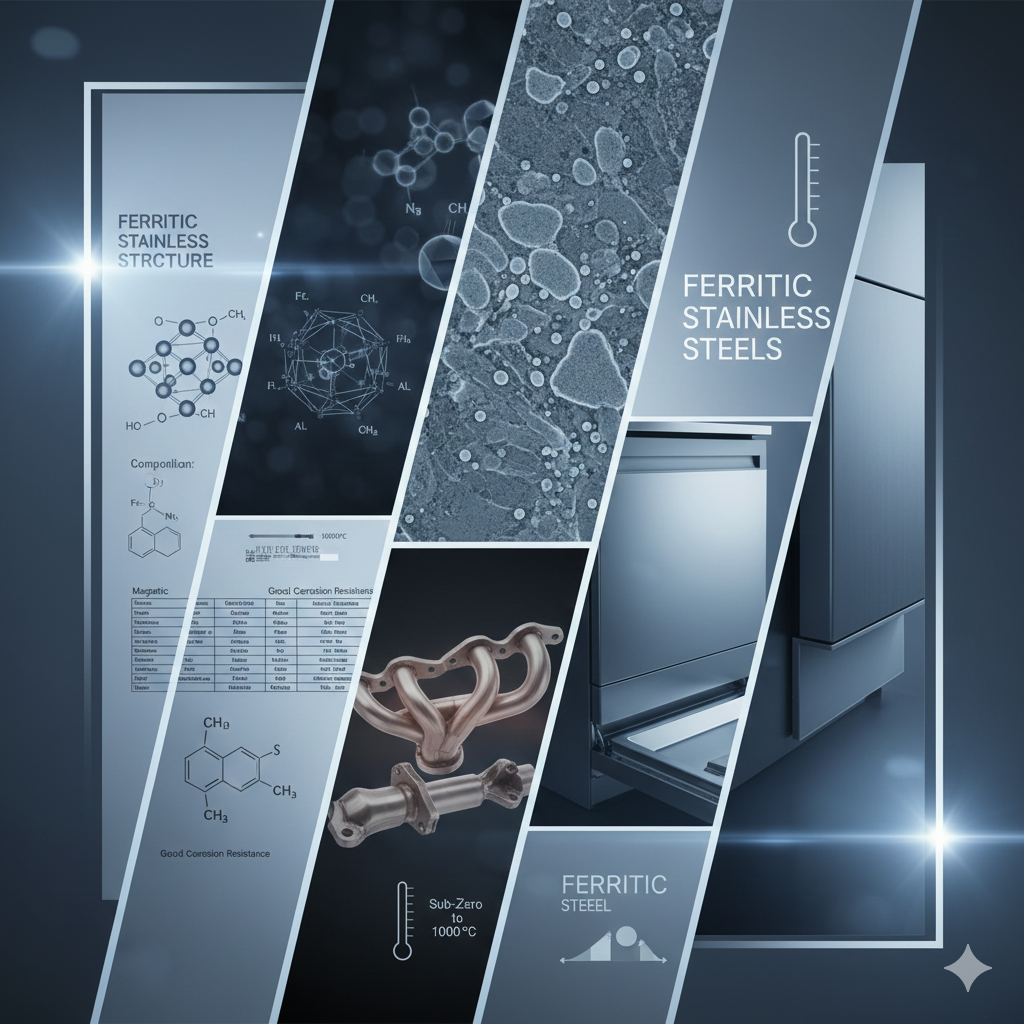
Ferritic stainless steels represent an important yet often underappreciated class of corrosion-resistant materials that combine practical engineering properties with significant economic advantages. While austenitic grades like 304 and 316 dominate stainless steel consumption worldwide, ferritic grades offer compelling alternatives for applications where their unique characteristics—magnetic properties, resistance to stress corrosion cracking, superior thermal conductivity, and lower material costs—provide distinct advantages. This comprehensive examination explores the metallurgy, properties, major grades, and engineering applications of ferritic stainless steels, providing designers and engineers with the knowledge needed to leverage these materials effectively.
Metallurgical Foundations: Understanding the Ferritic Structure
Ferritic stainless steels derive their name from their predominant microstructure: ferrite, the body-centered cubic (BCC) crystal structure that also characterizes plain carbon steels at room temperature. Unlike austenitic stainless steels, which contain sufficient nickel to stabilize the face-centered cubic (FCC) austenite structure, ferritic grades remain ferritic from room temperature through their melting point, never undergoing the allotropic transformation to austenite.
This fundamental structural difference drives many of the distinctive properties that differentiate ferritic from austenitic stainless steels. The BCC crystal structure exhibits different slip systems and dislocation behavior compared to FCC structures, affecting strength, ductility, and work-hardening characteristics. The absence of nickel—or minimal nickel content in some grades—substantially reduces material cost while maintaining adequate corrosion resistance through high chromium levels.
Ferritic stainless steels contain chromium as the primary alloying element, typically ranging from 10.5% to 30% depending on grade and application requirements. Chromium forms the passive chromium oxide film (Cr₂O₃) responsible for the "stainless" character. Higher chromium levels enhance corrosion resistance, particularly resistance to oxidizing environments and certain aggressive media.
Carbon content in ferritic stainless steels is deliberately minimized, typically below 0.08% and often below 0.03% in modern grades. This low carbon content serves multiple purposes: it maintains ferritic structure stability (carbon promotes austenite formation), improves weldability by reducing carbide precipitation, enhances formability, and reduces the tendency for sensitization—chromium carbide precipitation that depletes chromium from grain boundaries, creating corrosion-susceptible zones.
Interstitial elements nitrogen and carbon, even in low concentrations, significantly affect ferritic stainless steel properties. Both elements act as potent solid solution strengtheners but severely reduce ductility and toughness, particularly at low temperatures. Modern ferritic grades employ vacuum or argon-oxygen decarburization (AOD) processes to achieve ultra-low carbon and nitrogen levels, dramatically improving fabricability and toughness compared to older high-carbon ferritic grades.
Key Characteristics and Properties
Ferritic stainless steels exhibit a distinctive property profile that makes them optimal for specific applications while limiting their suitability for others.
Magnetic Properties: All ferritic stainless steels are strongly ferromagnetic due to their BCC crystal structure. This magnetic response enables magnetic separation from non-magnetic materials, allows detection using magnetic inspection methods, and can be exploited in applications requiring magnetic permeability. Conversely, the magnetic character prevents use in applications requiring non-magnetic materials, such as certain medical devices or near sensitive electronic equipment.
Stress Corrosion Cracking Resistance: Perhaps the most significant advantage of ferritic stainless steels is their immunity to chloride-induced stress corrosion cracking (SCC)—a catastrophic failure mode affecting austenitic grades in chloride environments above approximately 60°C. The BCC structure of ferritics does not support the crack propagation mechanisms that cause SCC in FCC austenitic structures. This immunity makes ferritics attractive for applications involving sustained tensile stresses in chloride-containing environments where austenitic grades would be at risk.
Thermal Properties: Ferritic stainless steels exhibit thermal conductivity approximately 50% higher than austenitic grades—typically 25-28 W/m·K versus 16-18 W/m·K for 304/316 austenitic steels. This superior conductivity benefits heat exchanger applications by improving heat transfer efficiency. Ferritics also display lower thermal expansion coefficients (approximately 10-11 × 10⁻⁶/°C) compared to austenitics (17-18 × 10⁻⁶/°C), reducing thermal stress in components experiencing temperature cycling.
Mechanical Properties: Ferritic grades generally exhibit moderate strength levels—yield strengths typically 250-400 MPa depending on composition and processing—with adequate ductility for most forming operations. Work hardening rates are lower than austenitic grades, meaning ferritics don't strengthen as dramatically during cold working. This characteristic can be advantageous (less force required for forming) or disadvantageous (less strengthening available from cold work).
Toughness Limitations: The most significant limitation of ferritic stainless steels is their ductile-to-brittle transition behavior. Unlike austenitic grades that maintain ductility to cryogenic temperatures, ferritics undergo a transition from ductile behavior at higher temperatures to brittle behavior below a transition temperature, typically between -20°C and +60°C depending on composition and grain size. Large grain size, high interstitial content, and certain alloying elements raise the transition temperature, potentially limiting low-temperature applications. Modern low-interstitial grades with refined grain structures have substantially lowered transition temperatures compared to older ferritic grades.
Corrosion Resistance: Ferritic stainless steels provide good general corrosion resistance in many environments, particularly oxidizing conditions. Resistance to atmospheric corrosion, fresh water, and many chemicals makes ferritics suitable for architectural, automotive, and industrial applications. However, resistance to pitting and crevice corrosion in chloride environments, while adequate for many applications, does not match high-molybdenum austenitic grades or super duplex steels. The absence of nickel and molybdenum in basic ferritic grades limits performance in aggressive chloride media.
Major Ferritic Stainless Steel Grades
Ferritic stainless steels span a range of compositions optimized for different property requirements and applications.
Type 409 (UNS S40900)
Type 409 represents the most widely produced ferritic grade globally, consuming vast tonnages in automotive exhaust systems. The composition contains approximately 11% chromium with titanium additions (6-8 × carbon content minimum) that stabilize carbon by forming titanium carbides rather than chromium carbides.
This titanium stabilization maintains corrosion resistance after welding and high-temperature exposure by preventing chromium depletion from grain boundaries. Type 409 offers adequate corrosion resistance for automotive exhaust environments—hot, moisture-laden combustion gases containing sulfur compounds—while providing formability for complex exhaust component shapes and weldability for exhaust system assembly.
The grade's moderate cost, good elevated-temperature oxidation resistance (to approximately 700-815°C), and adequate strength make it economically optimal for exhaust systems. Global automotive production consumes hundreds of thousands of tons annually. Beyond exhaust applications, Type 409 serves in mufflers, catalytic converter housings, heat shields, and other elevated-temperature components where its oxidation resistance and thermal expansion properties provide advantages over carbon steel.
Type 430 (UNS S43000)
Type 430, containing approximately 16-18% chromium, represents a general-purpose ferritic grade offering good corrosion resistance in mildly corrosive environments combined with moderate cost. The grade provides corrosion resistance superior to 409 due to higher chromium content, enabling applications in appliances, architectural trim, food processing equipment, and automotive decorative trim.
Type 430 exhibits good formability for stamping, drawing, and roll forming operations common in appliance and architectural applications. The material's magnetic properties and polishability make it suitable for decorative applications where surface appearance matters. However, 430's weldability is inferior to stabilized grades like 409 or 439—welding can cause grain growth in heat-affected zones, raising the brittle transition temperature and reducing toughness.
Common applications include refrigerator panels, dishwasher components, range hoods, automotive trim, interior architectural panels, and utensils. The grade serves applications requiring better corrosion resistance than carbon steel, magnetic properties, and lower cost than austenitic grades, provided welding requirements are minimal or can accommodate 430's welding limitations.
Type 439 (UNS S43035)
Type 439 improves upon 430 by adding titanium stabilization, enhancing weldability, and reducing sensitization tendencies. The composition typically contains 17-19% chromium with titanium stabilization similar to 409. This combination provides 430-level corrosion resistance with significantly improved fabricability.
The titanium stabilization prevents carbide precipitation during welding and elevated-temperature exposure, maintaining ductility and corrosion resistance in weldments. This makes 439 suitable for applications requiring extensive welding that would be problematic with 430.
Applications include automotive exhaust components requiring better corrosion resistance than 409, appliance parts involving welded assemblies, water heater tanks, and heat exchangers. The grade represents a middle ground between 409's economy and higher-alloy grades' corrosion resistance.
Type 444 (UNS S44400)
Type 444 represents a significant upgrade in corrosion resistance through molybdenum addition (1.75-2.5%) combined with approximately 18% chromium. The molybdenum substantially enhances resistance to pitting and crevice corrosion in chloride-containing environments, approaching or matching 316 austenitic stainless steel in many applications.
The grade combines this enhanced corrosion resistance with ferritic advantages: immunity to chloride stress corrosion cracking, higher thermal conductivity than austenitics, lower thermal expansion, and moderate cost (more expensive than 430 but less than 316 due to absent or minimal nickel). Titanium or niobium stabilization provides good weldability.
Type 444 finds applications in hot water tanks, heat exchangers handling brackish or chlorinated water, coastal architectural panels, industrial equipment exposed to moderate chloride levels, and chemical processing equipment. The material serves effectively in applications where 316 might be specified primarily for chloride SCC resistance rather than absolute corrosion resistance, allowing cost savings while maintaining adequate performance.
High-Chromium Ferritic Grades (446, E-Brite 26-1)
Ferritic grades containing 26-29% chromium provide exceptional corrosion resistance in specific aggressive environments. Type 446 (UNS S44600) with approximately 25% chromium exhibits outstanding high-temperature oxidation resistance to 1100°C, making it suitable for furnace parts, heat treating equipment, and industrial heating elements.
E-Brite 26-1 (UNS S44627), containing approximately 26% chromium with molybdenum addition and ultra-low carbon/nitrogen (< 0.01%), represents a premium ferritic grade offering corrosion resistance approaching duplex stainless steels in many environments. The ultra-low interstitials provide excellent toughness and ductility compared to older high-chromium ferritics. Applications include heat exchangers in aggressive chemical environments, flue gas desulfurization equipment, and components exposed to hot chloride solutions.
These high-chromium grades cost more than common ferritics but substantially less than nickel-based alloys or super duplex steels, occupying a valuable niche for specific demanding applications.
Fabrication Characteristics
Understanding ferritic stainless steel fabrication characteristics is essential for successful component manufacturing and assembly.
Forming and Drawing: Ferritic stainless steels exhibit good formability for moderate deformation operations. However, they work-harden less than austenitic grades, limiting the amount of cold reduction achievable without intermediate annealing. Deep drawing operations may require annealing between stages, whereas austenitic grades can often complete draws without intermediate softening. The lower ductility compared to austenitics restricts minimum bend radii and maximum drawing ratios.
For optimal formability, ferritic stainless steels should be formed with the rolling direction rather than transverse to it, as directionality in properties is more pronounced than in austenitic grades. Proper die design, lubrication, and forming parameters account for the material's lower ductility and work-hardening characteristics.
Welding Considerations: Welding ferritic stainless steels presents challenges not encountered with austenitic grades. The weld thermal cycle causes grain growth in heat-affected zones, particularly in non-stabilized grades like 430. Coarse grain size elevates the ductile-brittle transition temperature, potentially resulting in brittle weldments at room temperature. This grain coarsening cannot be reversed by heat treatment in ferritic grades since they don't undergo phase transformations that would refine grain structure.
Stabilized grades (409, 439, 444) mitigate some welding issues through titanium or niobium additions that minimize chromium carbide precipitation. However, grain growth still occurs. Best practices for welding ferritics include minimizing heat input to limit grain growth, using appropriate filler metals (often slightly overalloyed to compensate for dilution), avoiding excessive restraint that creates residual stresses, and employing post-weld stress relief when possible to reduce transition temperatures.
Resistance welding (spot, seam) generally produces satisfactory results for thin sections. Laser and electron beam welding, with their low heat input and narrow heat-affected zones, often produce superior weldments compared to arc welding processes.
Machining: Ferritic stainless steels generally machine more readily than austenitic grades due to lower work-hardening rates and absence of extensive chip elongation. However, the ferrite structure can be abrasive to cutting tools, requiring appropriate tool materials and cutting parameters. Carbide or ceramic tooling extends tool life. Adequate cutting fluid, sharp tools, and positive rake angles produce good surface finishes and acceptable tool life.
Heat Treatment: Unlike austenitic grades that can be solution annealed and quenched to achieve specific properties, or precipitation-hardening grades that respond to aging treatments, ferritic stainless steels offer limited response to heat treatment. Annealing at 750-850°C softens work-hardened material and relieves stresses but doesn't significantly alter microstructure or properties beyond stress relief and recrystallization.
The lack of hardenability means ferritic grades cannot be strengthened through quenching and tempering operations applicable to martensitic stainless steels or carbon steels. Properties are primarily controlled through composition and cold working rather than heat treatment.
Engineering Applications Across Industries
Ferritic stainless steels serve diverse applications across multiple industries, each leveraging specific advantageous properties.
Automotive Industry
The automotive sector represents the largest single consumer of ferritic stainless steels, predominantly Type 409 and 439 in exhaust systems. Modern emission control regulations requiring catalytic converters, exhaust gas recirculation systems, and durable exhaust components have driven extensive ferritic stainless steel adoption.
Exhaust manifolds, catalytic converter housings, mufflers, tailpipes, resonators, and exhaust hangers utilize ferritic grades for their combination of oxidation resistance at elevated temperatures (400-900°C), adequate corrosion resistance to combustion products, formability for complex geometries, weldability for assembly, and acceptable cost for high-volume production.
The thermal expansion characteristics of ferritics closely match cast iron engine blocks and carbon steel chassis components, reducing differential thermal expansion stresses compared to using austenitic stainless steels. This compatibility minimizes joint stresses and extends component life.
Beyond exhaust systems, ferritics serve in fuel system components, decorative trim (taking advantage of magnetic properties for attachment), structural reinforcements, and various under-hood applications requiring heat and corrosion resistance.
Appliance Manufacturing
Residential and commercial appliances extensively utilize Type 430 and 439 ferritic stainless steels for both functional and decorative components. The bright, easily cleaned surfaces combined with adequate corrosion resistance and moderate cost make ferritics ideal for appliance applications.
Refrigerator doors and side panels, dishwasher tubs and doors, range hoods, cooktop surrounds, microwave oven cavities, and washing machine drums employ ferritic stainless steels. The materials resist household cleaning chemicals, maintain appearance through years of service, and provide magnetic properties useful for attaching accessories and decorative items.
The forming characteristics accommodate stamping and drawing operations producing complex appliance geometries. Polishing and finishing produce attractive appearances meeting consumer expectations for modern appliances.
Architectural and Building Construction
Architectural applications leverage ferritic stainless steels' corrosion resistance, appearance, and lower cost compared to austenitic grades for interior and moderate-exposure exterior applications. Interior column covers, elevator doors and panels, handrails, decorative trim, and ceiling panels commonly use Type 430.
For coastal or industrial environments requiring enhanced corrosion resistance, Type 444 provides upgraded performance approaching 316 austenitic stainless steel while maintaining cost advantages. Roofing, flashing, and cladding in marine environments benefit from 444's resistance to atmospheric chlorides.
The magnetic properties of ferritics facilitate installation using magnetic fasteners or temporary magnetic attachment during assembly. The lower thermal expansion reduces thermal stress in panels exposed to solar heating compared to austenitic alternatives.
Food Processing and Dairy Equipment
Food processing equipment, dairy tanks, brewing vessels, and commercial kitchen equipment use ferritic stainless steels for components requiring sanitary surfaces, corrosion resistance to food acids and cleaning chemicals, and moderate cost. Type 430 and 444 serve tanks, conveyor systems, processing vessels, and structural components.
While austenitic 304 and 316 grades dominate food contact surfaces requiring maximum corrosion resistance and sanitary characteristics, ferritics serve adequately in less critical applications or where chloride SCC immunity provides specific advantages. The materials resist the alkaline and chlorinated cleaning chemicals prevalent in food processing sanitation.
Water Heating and Plumbing
Residential and commercial water heaters increasingly specify Type 444 ferritic stainless steel for tanks and heat exchanger components. The material provides corrosion resistance to chlorinated potable water, resistance to pitting in warm water environments, and immunity to chloride SCC—critical for tank longevity.
Solar water heating systems, tankless water heaters, and heat pump water heaters benefit from 444's superior thermal conductivity compared to austenitic alternatives, improving heat transfer efficiency. The material serves in heat exchanger coils, storage tanks, and piping systems handling domestic water.
Chemical and Industrial Processing
While austenitic and duplex stainless steels dominate aggressive chemical processing applications, ferritics serve specific industrial niches where their properties provide advantages. Flue gas desulfurization (FGD) systems in power plants use high-chromium ferritics like 446 or E-Brite 26-1 for components exposed to hot, acidic, chloride-laden flue gases—conditions causing chloride SCC in austenitics.
Heat exchangers in moderately corrosive services, particularly where chloride SCC risk exists, may specify Type 444 as a cost-effective alternative to 316 austenitic or duplex grades. The combination of corrosion resistance, thermal conductivity, and SCC immunity provides compelling advantages for specific applications.
Material Selection Guidelines: When to Specify Ferritic Grades
Ferritic stainless steels represent optimal choices when several conditions align:
Ferritic grades are preferred when:
- Magnetic properties are required or acceptable
- Chloride stress corrosion cracking resistance is critical with sustained tensile stresses in chloride environments above 60°C
- Operating temperatures remain above the ductile-brittle transition temperature (typically above -20°C to +20°C for modern grades)
- Thermal conductivity advantages improve heat transfer or reduce thermal stresses
- Cost considerations favor ferritics over austenitic alternatives for moderate corrosion environments
- Moderate mechanical properties are adequate (yield strength 250-400 MPa)
- Corrosion resistance requirements match ferritic capabilities (general corrosion, moderate chlorides, oxidizing environments)
Alternative materials merit consideration when:
- Low-temperature service (below -20°C) requires assured ductility and toughness (favor austenitic grades)
- Maximum corrosion resistance to pitting and crevice corrosion in hot chloride environments is required (favor super austenitic or super duplex grades)
- Non-magnetic properties are mandatory (austenitic or special non-magnetic grades required)
- Extensive cold forming or deep drawing operations require maximum formability (austenitic grades superior)
- High strength exceeding 500 MPa is required (consider duplex, martensitic, or precipitation-hardening stainless steels)
- Extensive welding with maximum ductility in weldments is critical (austenitic grades generally superior)
Economic Considerations and Cost-Benefit Analysis
Ferritic stainless steels typically cost 60-80% of equivalent austenitic 304 stainless steel and 50-70% of 316 austenitic stainless steel on a per-kilogram basis. This cost advantage stems primarily from minimal or absent nickel content—nickel represents a significant cost component in austenitic grades and is subject to price volatility.
The economic case for ferritics strengthens when considering total system costs:
Material Weight: Lower density compared to austenitics (7.75 g/cm³ versus 7.9-8.0 g/cm³) provides 2-3% weight savings for equal volumes.
Thermal Efficiency: For heat exchanger applications, the superior thermal conductivity may enable smaller heat exchanger surface areas or improved thermal performance, offsetting material selection costs through reduced total heat exchanger costs or improved system efficiency.
Longevity: In applications where chloride SCC threatens austenitic grades, ferritics may provide longer service life by eliminating the most common stainless steel failure mode, reducing lifecycle costs through extended replacement intervals.
Fabrication Costs: Simpler forming (less springback, lower forces) and machining (less work hardening) may reduce fabrication costs compared to austenitic grades, though welding may be more expensive due to specialized procedures.
Conclusion: The Strategic Role of Ferritic Stainless Steels
Ferritic stainless steels occupy a strategic position in the materials selection landscape, offering property combinations unmatched by other stainless steel families. Their immunity to chloride stress corrosion cracking, superior thermal properties, magnetic characteristics, and cost advantages make them optimal solutions for specific demanding applications despite limitations in low-temperature toughness and maximum corrosion resistance.
Understanding the metallurgical basis for ferritic properties, recognizing the capabilities and limitations of major grades, and appreciating fabrication requirements enables engineers to specify ferritic stainless steels confidently where their advantages provide maximum value. The continued development of improved ferritic compositions—particularly ultra-low interstitial grades with enhanced toughness and higher-alloy grades with improved corrosion resistance—expands the application envelope, ensuring ferritic stainless steels remain important engineering materials serving critical functions across automotive, appliance, architectural, and industrial sectors for decades to come.
As industries increasingly emphasize lifecycle cost analysis over initial material cost, and as applications in chloride environments proliferate, ferritic stainless steels' unique combination of corrosion resistance, mechanical properties, and economic value positions them for continued growth and adoption in applications where their specific advantages align with design requirements.

