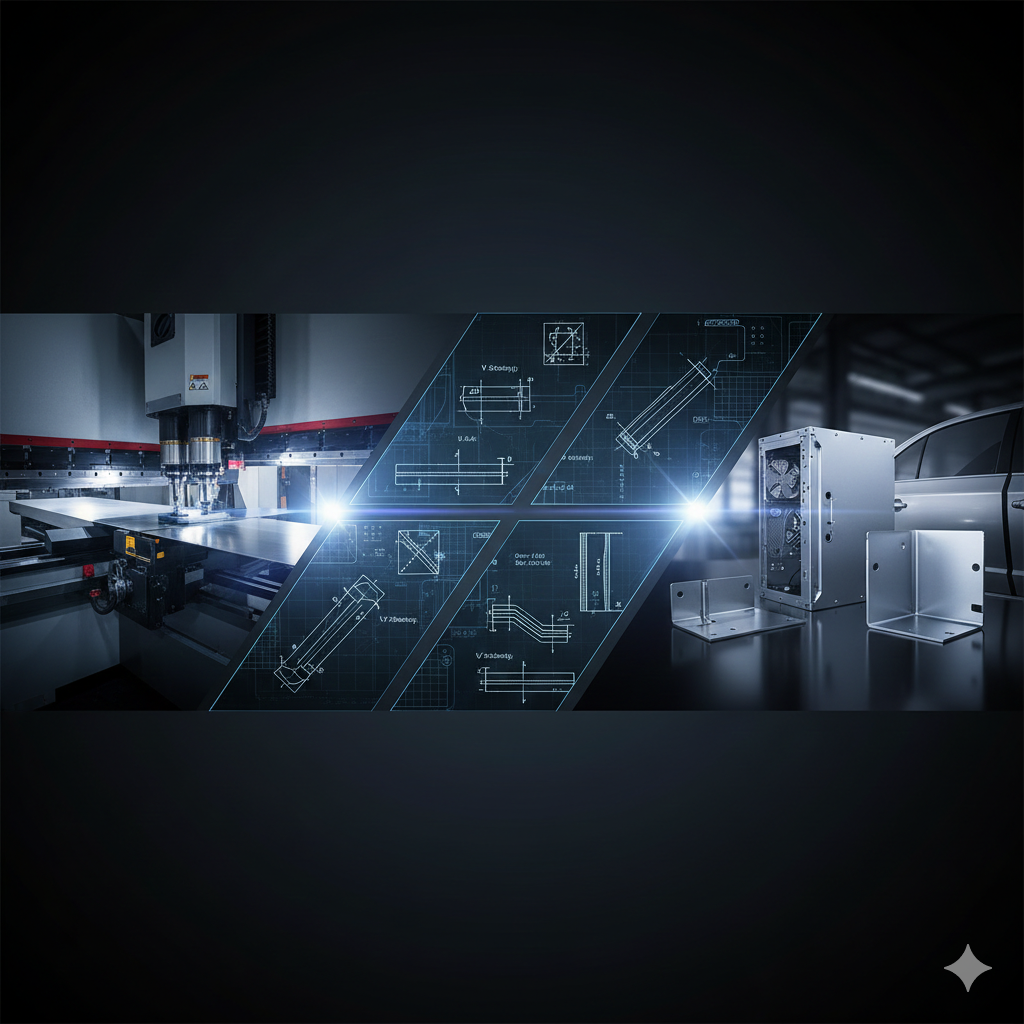
Sheet metal bending stands as one of the most fundamental and versatile manufacturing processes in modern industry, transforming flat metal sheets into complex three-dimensional components found in everything from consumer electronics to aircraft structures. This seemingly simple process of applying force to create angular deformations involves sophisticated understanding of material behavior, precision tooling, and careful process control. This comprehensive exploration examines the mechanics underlying sheet metal bending, surveys the diverse processes and equipment employed, analyzes the benefits driving widespread adoption, and reveals the breadth of real-world applications where bent sheet metal components serve critical functions.
The Fundamental Mechanics of Metal Bending
At its core, sheet metal bending represents a plastic deformation process where metal is stressed beyond its elastic limit, creating permanent angular changes while (ideally) avoiding fracture or unacceptable surface defects. Understanding the mechanics requires examining what occurs within the material during the bending operation.
When a sheet metal blank is bent, the material experiences a complex stress state. The outer surface of the bend undergoes tensile stress and elongates, while the inner surface experiences compressive stress and contracts. Between these surfaces lies the neutral axis—a theoretical plane where material neither elongates nor compresses, maintaining its original length. The position of this neutral axis shifts slightly inward from the geometric centerline during bending, typically residing at approximately 0.3-0.5 times the material thickness from the inner surface, depending on the bend radius and material properties.
The relationship between bend radius and material thickness critically affects formability and final part quality. A tight bend radius relative to material thickness induces higher surface strains. If tensile strain on the outer surface exceeds the material's elongation capacity, cracking occurs. Conversely, excessively tight bends can cause buckling or wrinkling on the compressed inner surface. Industry standards typically specify minimum bend radius as a multiple of material thickness—commonly 1T to 3T (where T equals thickness) for ductile materials like aluminum and mild steel, increasing to 4T-8T for less ductile materials or harder tempers.
Springback represents one of the most significant challenges in sheet metal bending. After the bending force is removed, internal elastic stresses partially recover, causing the bend angle to open slightly. The magnitude of springback depends on material properties (yield strength, elastic modulus, work hardening behavior), bend geometry (angle, radius), and process parameters. Materials with high yield strength relative to elastic modulus—such as high-strength steels, stainless steels, and hardened aluminum alloys—exhibit greater springback than soft, ductile materials. Compensating for springback requires over-bending the material during forming, with the precise over-bend amount determined through calculation, simulation, or empirical testing.
The K-factor quantifies neutral axis position and enables accurate bend deduction calculations for flat pattern development. K-factor values typically range from 0.3 to 0.5, varying with material type, thickness, and bend radius. Accurate K-factor determination is essential for calculating the developed length of bent parts, ensuring that the starting blank dimensions produce parts meeting dimensional specifications after bending.
Air Bending: Flexibility and Efficiency
Air bending, also called partial bending or free bending, represents the most common sheet metal bending method in modern fabrication shops. The process positions the workpiece on two support points (the die shoulders) while a punch descends to press the material into a V-shaped die opening. Critically, the punch does not contact the bottom of the die; instead, it penetrates to a controlled depth, with the final bend angle determined by punch penetration depth rather than die geometry.
This characteristic provides air bending's primary advantage: tooling flexibility. A single punch and die combination can produce a wide range of bend angles simply by varying punch penetration depth. A 90° V-die with appropriate opening width can create bends from approximately 85° to 180° using the same tooling by adjusting ram position. This versatility dramatically reduces tooling inventory requirements and setup time compared to methods requiring dedicated tooling for each bend angle.
Air bending requires relatively low bending force compared to other methods—typically one-third to one-half the force needed for bottoming or coining. This reduced force requirement enables bending thicker materials or longer bends on available equipment, extending machine capability. The lower forces also reduce tool wear, extending tooling life and reducing maintenance costs.
However, air bending exhibits greater sensitivity to material property variations than bottoming or coining. Since the final angle depends on achieving a specific penetration depth where elastic and plastic deformation balance, variations in material yield strength, thickness, or hardness affect the final angle. Materials from different lots or suppliers may require process adjustments to maintain consistent angles. The method also produces greater springback than bottoming or coining, demanding accurate springback compensation in punch positioning.
Typical air bending applications span electronics enclosures, HVAC ductwork, appliance panels, automotive brackets, and general fabrication where flexibility and efficiency outweigh the need for absolute angle precision and minimum springback.
Bottoming: Enhanced Accuracy and Reduced Springback
Bottoming, also termed bottom bending or die bending, advances beyond air bending by pressing the workpiece firmly against the die bottom throughout the punch stroke's final portion. The punch presses the material into full contact with the die cavity profile, more completely defining the bend geometry through die shape rather than punch position alone.
This fuller die contact provides several advantages. Dimensional consistency improves because the bend angle is largely determined by die geometry rather than solely by punch penetration depth, reducing sensitivity to material property variations. Parts bent by bottoming exhibit less variation in final angles across production lots even when material properties vary within specification ranges.
Springback reduction occurs because the higher forming forces and fuller material constraint during bottoming reduce elastic recovery compared to air bending. While springback is not entirely eliminated, it decreases by approximately 30-50% compared to equivalent air bending operations, simplifying compensation and improving angle accuracy.
Bottoming requires higher forces than air bending—typically 3-5 times greater—due to the need to press material firmly against die surfaces. This increased force requirement may limit the thickness or length of bends achievable on given equipment. Tool wear also increases with the higher forces and fuller die contact. Die and punch must be precisely matched to avoid marking or damaging workpiece surfaces.
The method finds application where improved angle accuracy and consistency justify the higher tooling costs and setup requirements: precision brackets, structural components, enclosures requiring tight tolerance assembly, and applications where springback compensation difficulties favor bottoming's inherent springback reduction.
Coining: Maximum Precision and Surface Quality
Coining represents the most force-intensive bending method, applying sufficient pressure to compress the material beyond yielding to induce plastic flow throughout the bend region. The process name derives from coin minting, where similar high pressures imprint fine detail into metal blanks.
During coining, forces typically 5-10 times greater than air bending compress the material between punch and die with such intensity that the entire bend region yields plastically, with material flowing to conform completely to tooling geometry. This extreme forming pressure produces several distinctive characteristics.
Springback is virtually eliminated. The high forming pressure and complete plastic deformation throughout the bend region minimize elastic recovery, producing bend angles matching die geometry with minimal compensation required. This near-elimination of springback enables consistent, repeatable angles even with high-strength materials that exhibit substantial springback in air bending.
Surface finish improves as the compressive forces burnish material surfaces against precision-ground die surfaces, potentially improving surface roughness and appearance. Sharp, well-defined bend radii result from the complete conformance to tooling geometry.
Material thinning occurs more noticeably than in air bending or bottoming. The extreme compressive forces at the bend apex reduce material thickness in the bend region, sometimes by 10-30% depending on material and process parameters. This thinning must be considered in strength calculations and may limit application to parts where localized thickness reduction is acceptable.
The high forces required for coining demand heavy-duty equipment—press brakes with significantly higher tonnage ratings than needed for equivalent air bending operations. Tooling must be extremely robust and precisely manufactured to withstand the forces without deflection or damage. Tool wear rates increase substantially, raising tooling costs and maintenance requirements.
Coining finds application where precision bend angles and minimal springback are paramount and justify the higher costs: aerospace components requiring tight tolerances, precision instruments, decorative parts requiring sharp, consistent bends, and applications where material springback would otherwise compromise assembly or function.
Specialized Bending Processes
Beyond these primary methods, specialized bending processes address specific geometric requirements or material challenges.
Hemming creates folded edges, typically 180° bends where material folds back against itself, for edge stiffening, safety (eliminating sharp edges), or joining. Door panel hemming in automotive manufacturing joins inner and outer door panels through peripheral hems. The process may occur in multiple stages—first creating an open hem around 30-45°, then closing to 180° to avoid material bunching or wrinkling.
Wipe Bending uses a punch to wipe material around a radius form while clamping the remainder of the blank. This method suits bending near edges or creating bends where air bending's die opening would extend beyond the part boundary. Wipe bending finds extensive use in small parts, close-to-edge bends, and z-bends where successive opposite-direction bends create offset sections.
Rotary Bending employs rotating tools that progressively form bends through continuous motion rather than linear pressing. This method reduces marking and scratching of sensitive surfaces—valuable for pre-painted materials, polished metals, or soft materials prone to surface damage. Rotary bending also accommodates materials prone to cracking in conventional bending by distributing deformation more gradually.
Roll Bending creates large-radius curves and cylinders by passing sheet metal through a set of rollers arranged to gradually form the curvature through multiple passes. The process produces pipe, large-diameter cylinders, and curved panels for tanks, pressure vessels, and architectural applications. Unlike press brake bending which creates angular bends, roll bending produces smooth curves without discrete bend lines.
Stretch Bending simultaneously stretches and bends material, commonly used for forming aircraft skin panels and automotive body panels with complex compound curves. The process applies tension while bending, reducing wrinkling and improving shape control for large, thin panels.
Press Brake Technology and Control Systems
Modern press brakes—the primary equipment for sheet metal bending—have evolved dramatically from simple mechanical machines to sophisticated CNC-controlled systems integrating multiple technologies for precision and automation.
Mechanical Press Brakes use flywheels, clutches, and crank mechanisms to convert motor rotation into linear ram motion. These machines provide high force capacity and rapid cycling but offer limited control over ram position and speed during the stroke. Mechanical press brakes suit high-volume production of simple bends where speed outweighs flexibility.
Hydraulic Press Brakes employ hydraulic cylinders to power ram motion, providing superior control over force, position, and speed throughout the stroke. Modern hydraulic systems enable programmable ram speed profiles, adjustable dwell times at bottom positions, and precise positioning. The majority of modern press brakes use hydraulic actuation for its controllability and flexibility.
Servo-Electric Press Brakes use electric servo motors driving ball screws or other mechanical linkages to move the ram. These machines offer excellent precision, energy efficiency (consuming power only during actual bending), quiet operation, and reduced maintenance compared to hydraulics. Initial costs exceed hydraulic machines, but lifecycle costs may favor servo-electric systems for suitable applications.
CNC Control Systems have revolutionized press brake operation. Modern CNC controllers manage:
- Ram positioning with micron-level precision
- Automatic springback compensation based on material database information
- Backgauge positioning for accurate bend locations
- Sequential bend programs storing complete part bending sequences
- Graphical programming interfaces displaying 3D part models and bend sequences
- Collision detection preventing tool or part interference
- Automated crowning systems compensating for deflection in long bends
Advanced systems incorporate angle measurement feedback using laser or mechanical sensors that directly measure bend angles during forming, enabling closed-loop control that automatically adjusts ram position to achieve target angles regardless of material variations.
Benefits Driving Widespread Adoption
Sheet metal bending's dominance in manufacturing stems from multiple compelling advantages over alternative processes.
Cost Efficiency: Bending requires minimal material waste compared to machining—the starting blank converts almost entirely to finished part with only small trim scraps. No material is removed in chips or turnings as in machining. Tooling costs are modest compared to stamping dies, particularly for low-to-medium production volumes. A single press brake with standard tooling can produce hundreds of different part geometries without dedicated tooling for each part.
Flexibility: Press brake bending accommodates part design changes rapidly. Modifying bend angles, locations, or sequences requires only program changes rather than new tooling fabrication. This flexibility supports prototype development, custom fabrication, and rapid response to engineering changes. Small lot sizes down to single pieces are economically viable.
Strength and Stiffness: Bends inherently stiffen sheet metal through geometry, creating structural ribs that dramatically increase bending stiffness and buckling resistance. A flat sheet offers minimal resistance to deflection perpendicular to its plane, but adding bends creates rigidity. This strength-to-weight optimization enables lightweight structures meeting strength requirements with minimal material.
Speed: Simple bends can be completed in seconds. CNC press brakes with automated backgauge positioning and tool changing produce complex parts with multiple bends in minutes. Compared to welding fabrications requiring multiple operations and joint preparation, bent parts often reach completion faster with fewer process steps.
Design Freedom: Bending enables complex three-dimensional geometries from flat blanks. Enclosures, brackets, channels, and structural components with multiple bends create forms impractical or impossible through alternative processes. The ability to create complex shapes without joining operations eliminates potential failure points associated with welds or fasteners.
Quality and Repeatability: CNC control ensures consistent bend angles and positions across production runs. Once programs are proven, parts replicate precisely batch after batch. Modern equipment routinely achieves bend angle tolerances of ±0.5° or better and positional tolerances within ±0.1mm.
Real-World Applications Across Industries
Sheet metal bending serves as a fundamental process across virtually all manufacturing sectors, with applications ranging from mundane utility to safety-critical structures.
Aerospace and Aviation
Aircraft structures extensively employ bent sheet metal for ribs, stringers, brackets, fairings, and access panels. Aluminum alloys—predominantly 2024, 6061, and 7075—bend into complex profiles providing structural support while minimizing weight. Precision bending ensures aerodynamic contours and dimensional accuracy for assembly fit-up. The high strength-to-weight ratios achieved through optimized bent structures enable aircraft performance requirements while meeting stringent weight budgets.
Engine nacelles, interior panels, ducting for environmental control systems, and countless brackets and fittings rely on bent sheet metal fabrication. The aerospace sector demands rigorous quality control, with bending processes validated through first article inspections, in-process monitoring, and complete traceability.
Automotive Manufacturing
Automotive applications consume enormous tonnages of bent sheet metal. Structural components including cross members, seat frames, door beams, and underbody reinforcements provide crash energy absorption and structural rigidity. Exhaust systems employ extensively bent tubing and formed shields. Body panels, though typically stamped, may incorporate bent reinforcements and brackets.
The automotive industry's high-volume production demands rapid cycling, consistent quality, and minimal cost. Automated press brake cells with robotic material handling bend parts at rates exceeding 1,000 pieces per shift. The integration of bending with other fabrication operations in automated production lines exemplifies modern manufacturing efficiency.
Electronics and Telecommunications
Electronics enclosures, equipment racks, control panels, and chassis structures rely heavily on bent sheet metal construction. Aluminum and steel sheets bend into enclosures providing electromagnetic shielding, structural support for components, and mounting surfaces for hardware. The thermal conductivity of metal enclosures aids in heat dissipation from electronic components.
Server racks, network cabinets, industrial control panels, and consumer electronics housings demonstrate the range of bent sheet metal applications. Precision bending ensures proper fit of doors, panels, and hardware mounting points. Pre-painted or coated materials require careful handling during bending to avoid surface damage.
HVAC and Industrial Ventilation
Heating, ventilation, and air conditioning systems consist largely of bent sheet metal ductwork, plenums, and housings. Galvanized steel and aluminum sheet metal bend into rectangular, round, and oval duct sections that distribute conditioned air throughout buildings. Specialized bending equipment creates transitions, offsets, and branch connections from flat patterns.
The HVAC industry emphasizes production efficiency, with automated equipment producing duct components rapidly from computer-aided design data. Pittsburgh locks, snap locks, and other edge forms created through bending enable rapid duct assembly without fasteners.
Architectural and Construction
Building facades, roofing systems, flashings, and trim employ bent sheet metal extensively. Stainless steel, aluminum, and coated steel sheet metals bend into decorative and functional profiles. Standing seam metal roofs consist of formed panels with bent seams providing weather-tight joints. Architectural metalwork including column covers, canopies, and decorative elements showcases the aesthetic potential of precisely bent metal.
Structural metal studs for interior walls consist of cold-formed bent steel profiles. These lightweight yet strong framing members have largely replaced wood framing in commercial construction. The strength and dimensional stability of bent metal studs support modern building practices.
Industrial Equipment and Machinery
Machine guards, covers, panels, and structural components across industrial equipment rely on bent sheet metal fabrication. Equipment enclosures protect operators from moving machinery while providing access for maintenance. Conveyor systems, material handling equipment, and processing machinery incorporate countless bent sheet metal components.
The ability to customize bent components for specific equipment needs without expensive tooling makes bending ideal for capital equipment manufacturing where production volumes don't justify stamping die investments.
Furniture and Consumer Products
Office furniture, storage cabinets, shelving systems, and appliances utilize bent sheet metal extensively. Filing cabinets consist almost entirely of bent sheet metal panels joined through welds or mechanical fasteners. Metal desks, shelving brackets, and storage racks demonstrate bent metal's combination of strength, economy, and versatility.
Appliance manufacturers employ bending for internal brackets, mounting plates, and structural components. Even products primarily composed of other materials often incorporate bent metal brackets and mounting hardware.
Design Considerations for Bent Sheet Metal Parts
Successful bent sheet metal part design requires attention to multiple factors affecting manufacturability, cost, and performance.
Minimum Bend Radius: Specifying bend radii appropriate to material type and thickness prevents cracking. General guidelines suggest minimum inside radius of 1T for soft materials, increasing to 2T-3T for harder materials and tempers. Tighter radii may be achievable with annealing or alternative processes but risk material failure.
Bend Relief: Where bends intersect edges or other bends, relief cuts prevent material tearing. Small radius notches or rectangular cuts at bend termination points release stress concentrations that would otherwise cause cracking. Inadequate relief commonly causes manufacturing problems requiring design revision.
Hole-to-Bend Spacing: Holes near bend lines risk distortion during forming. Guidelines typically recommend minimum spacing of 2.5T between hole edges and bend lines to prevent elongation or distortion. Holes can be added after bending if closer spacing is required, though this adds operation cost.
Bend Sequence: Complex parts with multiple bends require careful consideration of bending sequence to avoid geometric interference between previously bent features and tooling. Some bend sequences become impossible due to physical interference. Design for manufacturability includes considering whether proposed geometries are achievable with practical tooling and sequencing.
Tolerances: Realistic tolerance specification balances functional requirements with manufacturing capability and cost. Standard press brake work achieves ±1° bend angles and ±0.5mm position tolerances economically. Tighter tolerances are achievable but increase process complexity and cost. Overspecifying tolerances where unnecessary drives up costs without functional benefit.
Future Directions and Emerging Technologies
Sheet metal bending technology continues advancing, integrating new capabilities and automation.
Artificial Intelligence and Machine Learning: AI systems are beginning to optimize bend sequencing, predict springback with greater accuracy by learning from production data, and recommend process parameters for unfamiliar materials or geometries. Machine learning algorithms analyze thousands of production parts to refine springback compensation models beyond traditional material database approaches.
Automated Offline Programming: Software systems generate complete bend programs from 3D CAD models, automatically determining bend sequences, calculating flat patterns, and creating CNC programs without manual programming. Integration with manufacturing execution systems enables lights-out manufacturing with minimal human intervention.
Collaborative Robotics: Collaborative robots work alongside human operators, handling material loading/unloading while operators manage quality oversight and complex setup tasks. This human-robot collaboration improves productivity while maintaining flexibility for mixed-production environments.
Additive-Subtractive Hybrid Manufacturing: Emerging systems combine sheet metal bending with 3D printing and machining in integrated work cells, enabling complex parts with features impossible through bending alone.
Advanced Sensors and Metrology: In-process measurement systems using laser scanning or vision systems measure part geometry during and after bending, enabling real-time quality verification and process feedback to correct deviations before complete production runs.
Conclusion: The Enduring Versatility of Sheet Metal Bending
Sheet metal bending's century-long dominance in manufacturing reflects fundamental advantages that remain compelling despite continuous technological evolution. The process efficiently transforms flat metal sheet into three-dimensional components with minimal material waste, excellent strength-to-weight ratios, and remarkable geometric flexibility. From multi-million-dollar aerospace structures to everyday brackets and enclosures, bent sheet metal components enable modern products and infrastructure.
The integration of CNC control, precision hydraulics, advanced materials science, and sophisticated software has transformed bending from a craft dependent on operator skill to a precisely controlled manufacturing process delivering micron-level accuracy and perfect repeatability. Yet the fundamental elegance remains—applying controlled force to exceed elastic limits and create permanent angular deformations that convert flat sheets into functional three-dimensional forms.
As manufacturing continues evolving toward mass customization, rapid product development cycles, and sustainable practices minimizing material waste, sheet metal bending's inherent flexibility, efficiency, and adaptability ensure its continued centrality to modern fabrication across all industries. The process that shaped the first metal vessels and tools thousands of years ago now enables spacecraft, medical devices, and nanotechnology equipment—testament to the enduring power of controlled plastic deformation to create useful form from flat material.