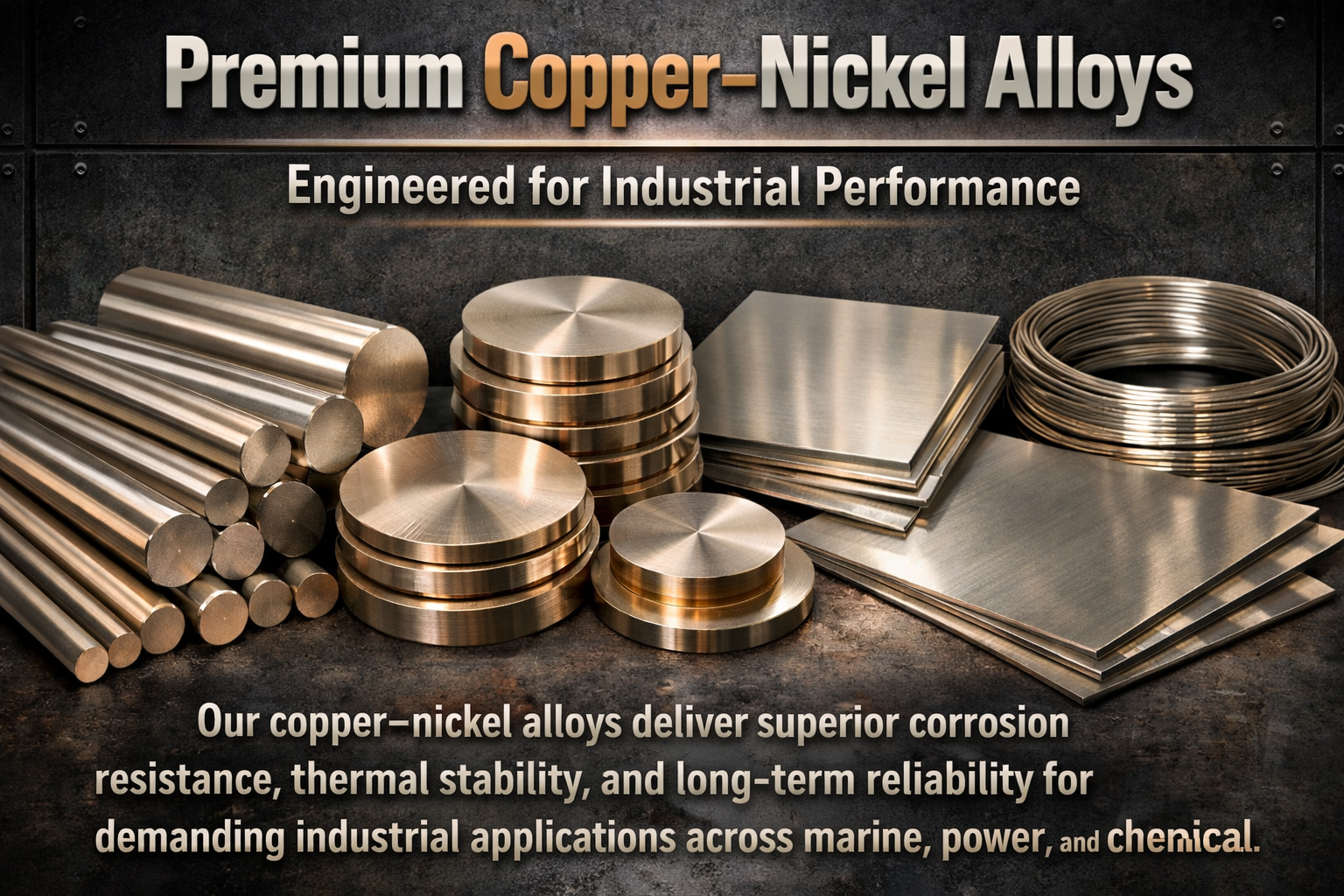
In the demanding landscape of modern industrial engineering, material selection often determines the difference between success and failure, between equipment that operates reliably for decades and systems plagued by premature failures and costly downtime. Copper-nickel alloys represent a pinnacle of metallurgical engineering, combining copper's excellent thermal conductivity and electrical properties with nickel's exceptional corrosion resistance to create materials that excel in some of the world's most challenging environments. At Shalco, we've dedicated ourselves to becoming the premier supplier of copper-nickel alloys, providing not just materials but comprehensive solutions that include technical expertise, quality assurance, competitive pricing, and unwavering customer support. Our commitment to excellence ensures that when engineers specify copper-nickel alloys for critical applications, they can rely on Shalco to deliver materials that meet or exceed the most stringent performance requirements.
The Metallurgy Behind Copper-Nickel Excellence
Understanding copper-nickel alloys begins with appreciating the unique metallurgical characteristics that emerge when these two elements are combined. Copper and nickel form a continuous solid solution across all compositions, meaning they mix completely at the atomic level rather than forming separate phases or compounds. This complete miscibility creates alloys with properties that vary smoothly with composition, allowing metallurgists to engineer specific property combinations by adjusting the copper-to-nickel ratio.
The addition of nickel to copper dramatically enhances corrosion resistance, particularly in marine environments and other chloride-containing solutions. While pure copper corrodes in seawater, copper-nickel alloys with as little as 10% nickel exhibit remarkable resistance to seawater attack. This resistance increases progressively with nickel content, with 30% nickel alloys providing exceptional protection even in the most aggressive marine conditions. The mechanism behind this resistance involves the formation of protective surface films that become increasingly stable and adherent as nickel content rises.
Simultaneously, copper's inherent thermal and electrical conductivity, though reduced by nickel additions, remains substantially higher than most engineering alloys. This combination of corrosion resistance with useful conductivity creates a unique position in the materials spectrum—copper-nickel alloys bridge the gap between pure copper (excellent conductivity but limited corrosion resistance) and nickel-rich alloys like Monel (excellent corrosion resistance but lower conductivity). This positioning makes copper-nickel alloys optimal for applications requiring both heat transfer efficiency and long-term durability in corrosive environments.
The alloys also exhibit excellent resistance to biofouling, the attachment and growth of marine organisms on submerged surfaces. This natural antifouling property, particularly pronounced in compositions with 10-30% nickel, reduces maintenance requirements and maintains heat transfer efficiency in marine heat exchangers. The mechanism involves copper ions released from the surface at rates sufficient to deter organism settlement without causing significant material loss.
Shalco's technical team understands these metallurgical fundamentals deeply, enabling us to guide customers toward optimal compositions for their specific applications and explain why copper-nickel alloys outperform alternatives in particular service conditions.
Standard Copper-Nickel Alloy Compositions
Commercial copper-nickel alloys are available in several standard compositions, each optimized for specific performance characteristics and application requirements.
90/10 Copper-Nickel (C70600, CuNi10Fe1Mn)
The 90/10 composition contains approximately 88-90% copper, 9-11% nickel, and 1.0-2.0% iron with manganese additions. This is the most economical copper-nickel alloy, offering substantial corrosion resistance improvement over pure copper at modest cost premium. The iron and manganese additions, though present in small quantities, significantly enhance the protective film formation that provides corrosion protection.
Applications include condenser and heat exchanger tubes in power plants and marine service, desalination plant equipment, shipboard piping systems, and offshore platform utilities. The 90/10 composition provides adequate performance for seawater temperatures up to approximately 60°C and moderate flow velocities. Shalco maintains substantial inventory of 90/10 tubing, pipe, plate, and other forms, recognizing this grade's widespread use across marine and industrial applications.
70/30 Copper-Nickel (C71500, CuNi30Mn1Fe)
The 70/30 composition contains approximately 66-69% copper, 29-33% nickel, with iron (0.4-1.0%) and manganese (0.5-1.0%) additions. This higher nickel content provides superior corrosion resistance compared to 90/10, extending performance to higher temperatures (up to 150°C), higher flow velocities, and more aggressive seawater conditions including polluted harbors and areas with high sulfide concentrations.
Critical applications include marine condenser tubes in naval vessels and high-performance commercial ships, offshore oil and gas platform heat exchangers, desalination plants with high operating temperatures, coastal power plant cooling systems, and shipboard piping in critical systems. The 70/30 composition justifies its higher cost through extended service life in demanding conditions where 90/10 would experience accelerated corrosion or erosion.
Shalco supplies 70/30 copper-nickel with complete mill certifications and can provide materials meeting naval specifications (MIL-T-16420), ASTM standards (B466, B467, B171), and other international specifications. Our quality systems ensure materials meet the stringent requirements of naval and critical commercial applications.
80/20 and Other Intermediate Compositions
Some applications specify intermediate compositions like 80/20 (approximately 79-81% copper, 19-21% nickel) that provide performance between 90/10 and 70/30. These grades optimize cost-performance balance for specific conditions. Regional variations exist, with some markets preferring slightly different compositions within the copper-nickel spectrum. Shalco can source these intermediate compositions when customer requirements or specifications demand them, leveraging our global supplier network to obtain materials meeting precise compositional targets.
Nickel Aluminum Bronze (Not True Copper-Nickel but Related)
While technically aluminum bronzes rather than copper-nickel alloys, nickel aluminum bronzes (NAB) deserve mention as they contain both copper (balance), aluminum (9-11%), nickel (4-5%), iron (4-5%), and manganese (1.5%). These alloys combine excellent seawater corrosion resistance with very high strength, making them suitable for propellers, pump impellers, valve components, and other applications requiring both corrosion resistance and mechanical properties. Shalco supplies nickel aluminum bronzes for customers requiring this property combination.
Superior Performance Characteristics
Copper-nickel alloys deliver a compelling array of properties that explain their specification across diverse demanding applications.
Exceptional Seawater Corrosion Resistance
The defining characteristic of copper-nickel alloys is their remarkable resistance to seawater corrosion. In marine service, these alloys develop protective surface films consisting of cuprous oxide and nickel compounds that effectively isolate the base metal from the corrosive environment. Film formation occurs rapidly upon initial seawater exposure and self-heals if damaged by erosion or mechanical cleaning.
General corrosion rates in quiescent seawater typically measure less than 2.5 micrometers per year—essentially negligible over decades of service. Under flowing conditions, corrosion rates increase modestly but remain acceptably low up to flow velocities of 2-3 meters per second for 90/10 and 3-5 meters per second for 70/30, significantly exceeding the erosion resistance of materials like admiralty brass or aluminum brass.
Pitting and crevice corrosion, severe problems for stainless steels in seawater, rarely occur with copper-nickel alloys. The continuous protective film prevents the localized breakdown that initiates these damaging corrosion forms. This immunity to localized corrosion provides major advantages in heat exchanger tubes where pitting often causes stainless steel failures.
Stress corrosion cracking, another failure mechanism affecting other alloys in marine service, does not occur in copper-nickel alloys under normal seawater conditions. This immunity eliminates a major failure mode that can cause sudden, catastrophic failures in susceptible materials.
Natural Antifouling Properties
Marine biofouling—the attachment and growth of organisms like barnacles, mussels, algae, and bacteria—degrades heat transfer efficiency, increases flow resistance, and accelerates corrosion through microbiologically influenced mechanisms. Copper-nickel alloys naturally resist biofouling through copper ions released from the surface at rates sufficient to deter organism settlement.
This natural resistance reduces or eliminates the need for biocide treatments, mechanical cleaning, and other fouling mitigation measures required with materials like titanium or stainless steel. In heat exchangers, maintaining clean tube surfaces preserves thermal efficiency and eliminates the performance degradation that occurs as other materials become fouled. Naval vessels particularly value this property, as reduced biofouling improves hull efficiency and reduces maintenance intervals.
The antifouling effect is most pronounced in 70/30 alloy but remains effective in 90/10 compositions. Unlike toxic antifouling coatings that eventually wear away requiring reapplication, copper-nickel's resistance is inherent to the material and lasts the equipment's entire service life.
Excellent Thermal Conductivity
While lower than pure copper, copper-nickel alloys maintain thermal conductivity far exceeding most corrosion-resistant alloys. The 90/10 composition achieves thermal conductivity approximately 50 W/m·K, while 70/30 provides around 30 W/m·K. These values, though half or less of pure copper's conductivity, dramatically exceed stainless steel (15-20 W/m·K) or titanium (7-20 W/m·K depending on grade).
This conductivity advantage translates directly to heat exchanger efficiency. For equivalent heat transfer, copper-nickel tubes can use thinner walls or smaller surface areas compared to lower-conductivity alternatives, reducing size, weight, and cost. The conductivity remains stable over time as surface films don't significantly impede heat transfer, whereas fouling on non-copper alloys continuously degrades thermal performance.
Mechanical Properties and Fabricability
Copper-nickel alloys provide moderate strength adequate for most applications. Tensile strength typically ranges from 340-450 MPa depending on composition and temper, with yield strength around 130-280 MPa. These values suffice for pressure vessels, piping systems, and heat exchangers operating at moderate pressures and temperatures.
Ductility remains excellent, with elongations typically exceeding 30-40%, allowing significant deformation during fabrication without cracking. This ductility facilitates tube expansion into tubesheets, bending for piping systems, and other forming operations. The alloys work harden moderately during cold working, with properties increasing predictably with deformation.
Fabrication using conventional methods proceeds smoothly. The alloys can be hot worked at 750-950°C, cold worked at room temperature, annealed at 600-750°C to restore ductility, welded using standard processes (GTAW, GMAW preferred) with appropriate copper-nickel filler metals, machined with sharp tools and adequate cooling, and brazed or soldered using appropriate techniques and materials.
Shalco provides technical guidance on fabrication procedures, welding parameters, and forming techniques to help customers successfully manufacture components from copper-nickel materials.
Temperature Capabilities
Copper-nickel alloys maintain useful properties across broad temperature ranges. Low-temperature performance remains excellent down to cryogenic temperatures, with no ductile-to-brittle transition. This characteristic enables use in LNG service and other cryogenic applications.
Upper temperature limits depend on composition and environment. In seawater, 90/10 performs well to approximately 60-70°C, while 70/30 extends performance to 150°C or higher. In non-oxidizing atmospheres, copper-nickel alloys resist oxidation to 300-400°C. Prolonged exposure to elevated temperatures can cause gradual softening through annealing effects, but for typical industrial cycles, properties remain stable.
Critical Industrial Applications
Copper-nickel alloys serve essential roles across industries where their unique property combination provides optimal solutions.
Marine Heat Exchangers and Condensers
The largest application for copper-nickel alloys is marine condensers and heat exchangers where seawater serves as cooling medium. Naval vessels including aircraft carriers, destroyers, submarines, and support ships specify copper-nickel tubes for condensers, auxiliary coolers, and various heat exchange applications. The alloys' corrosion resistance, antifouling properties, and thermal performance ensure reliable operation throughout decades of service without tube failures that would compromise mission capability.
Commercial shipping including container vessels, tankers, bulk carriers, cruise ships, and ferries increasingly specify copper-nickel for main condensers and auxiliary heat exchangers. The reliability and low maintenance requirements offset higher initial costs through reduced downtime and extended service life.
Offshore platforms use copper-nickel heat exchangers for cooling critical equipment, process streams, and power generation systems. The harsh marine environment, combined with limited maintenance access, makes reliability paramount, and copper-nickel's proven durability justifies its specification. Shalco supplies substantial tonnage of copper-nickel tubing and plate to marine heat exchanger manufacturers and shipbuilders worldwide.
Coastal Power Generation
Power plants located along coastlines face aggressive seawater cooling water that rapidly attacks ordinary materials. Copper-nickel tubes in main condensers and auxiliary heat exchangers provide decades of reliable service where stainless steel, titanium, or aluminum brass might require replacement after years or even months of operation.
The combination of corrosion resistance preventing tube failures, thermal conductivity maintaining efficiency, and antifouling properties reducing cleaning requirements makes copper-nickel economically optimal despite higher initial costs. Major coastal power plants globally rely on copper-nickel condensers, with some installations operating successfully for 40+ years on original tubing.
Desalination plants present particularly aggressive conditions combining high temperatures, high salinity, and chemical additives. The 70/30 composition excels in these demanding applications, providing corrosion resistance that enables reliable fresh water production. Shalco serves the desalination industry with materials meeting specifications for multi-stage flash (MSF) and reverse osmosis (RO) plants.
Offshore Oil and Gas Production
Offshore platforms require cooling systems for power generation, process equipment, and living quarters cooling. The combination of remote location, harsh environment, and high failure costs makes material reliability critical. Copper-nickel heat exchangers, piping systems, and firewater systems provide dependable performance throughout platform operational life.
Subsea equipment occasionally specifies copper-nickel for specific applications requiring both corrosion resistance and thermal conductivity. While not as prevalent as in topside applications, the alloy serves niche roles in subsea systems. Shalco supplies copper-nickel materials to offshore fabricators with certifications and documentation meeting oil company specifications and industry standards.
Marine Piping Systems
Shipboard piping for seawater service including fire mains, ballast systems, cooling water distribution, sanitary systems with seawater flushing, and deck washing systems specifies copper-nickel for long-term reliability. The alloys resist corrosion, erosion, and fouling that can degrade carbon steel or inferior materials, ensuring systems remain functional throughout vessel life.
Naval specifications often mandate copper-nickel for critical systems where reliability cannot be compromised. Commercial vessels increasingly specify copper-nickel for seawater piping, recognizing that lifecycle costs favor corrosion-resistant materials despite higher initial investment. Shalco supplies copper-nickel pipe, fittings, flanges, and valves for marine piping applications.
Architectural and Structural Applications
Coastal buildings, bridges, and structures benefit from copper-nickel's marine corrosion resistance and attractive appearance. Cladding, roofing, flashing, fasteners, and structural components using copper-nickel develop protective patinas and resist corrosion for decades with minimal maintenance. The alloys' natural appearance, evolving to distinctive greenish patinas, provides aesthetic appeal in addition to functionality.
Monuments and architectural features in coastal or industrial environments use copper-nickel for longevity and corrosion resistance. While representing smaller volume compared to heat exchanger applications, architectural uses showcase the material's versatility. Shalco supplies copper-nickel sheet, plate, and extrusions for architectural applications worldwide.
Coinage and Specialized Applications
Some countries use copper-nickel alloys for coinage, valuing their corrosion resistance, wear resistance, and distinctive color and feel. While not a primary market, coinage represents steady demand for specific compositions and tolerances.
Specialized applications include instrument components requiring corrosion resistance and electrical conductivity, marine hardware including shackles, turnbuckles, and deck fittings, chemical processing equipment handling specific corrosive environments, and other niche uses leveraging copper-nickel's unique properties.
Quality Standards and Specifications
Copper-nickel alloys are governed by numerous international standards ensuring materials meet performance requirements.
ASTM Standards
The American Society for Testing and Materials publishes comprehensive specifications including ASTM B466 and B467 for seamless copper-nickel pipe and tube, ASTM B171 for copper-nickel plate and sheet, ASTM B151 and B152 for copper-nickel rod, bar, and shapes, and ASTM B395 for U-bend copper-nickel tubing for heat exchangers. These specifications define chemical composition, mechanical properties, dimensions, tolerances, and testing requirements.
Military Specifications
Naval applications reference military specifications including MIL-T-16420 for copper-nickel condenser and heat exchanger tubes, MIL-T-15005 for copper-nickel pipe, and various other MIL-specs covering specific applications and forms. These specifications often include additional testing, documentation, and quality requirements beyond commercial standards.
International Standards
European standards (EN), Japanese standards (JIS), and other regional specifications govern copper-nickel alloys in their respective markets. Shalco maintains expertise in multiple standard systems, ensuring materials comply with applicable specifications regardless of customer location or project requirements.
Shalco's Quality Assurance
Every Shalco copper-nickel shipment includes comprehensive mill test reports documenting chemical composition verified by spectrographic analysis, mechanical properties from tensile testing, heat treatment history, dimensional verification, and traceability to original ingot or melt. For critical applications, additional testing includes ultrasonic examination of tubing for internal defects, eddy current testing for surface and near-surface discontinuities, hydrostatic testing for pressure-containing components, and specialized corrosion testing when specified.
Our quality management system maintains ISO certification and includes procedures ensuring proper material identification, handling, and storage throughout our facilities. This prevents mix-ups and ensures customers receive exactly the materials they ordered with properties meeting specifications.
Cost Considerations and Value Analysis
Copper-nickel alloys command premium pricing compared to carbon steel, admiralty brass, and even some stainless steels. However, total lifecycle cost analysis often demonstrates copper-nickel's economic superiority for marine and corrosive applications.
Initial material costs for 90/10 copper-nickel typically run 3-5 times carbon steel prices, while 70/30 costs approximately 5-7 times carbon steel. These premiums reflect base metal costs (copper and nickel are expensive compared to iron), alloying complexity, and more limited production volumes compared to commodity materials.
However, lifecycle considerations shift the economic equation dramatically. Extended service life with copper-nickel installations operating 30-40+ years compared to 5-15 years for inferior materials, reduced maintenance through corrosion and fouling resistance minimizing inspection and repair requirements, eliminated replacement costs avoiding expensive retubing or equipment replacement, maintained performance as heat transfer efficiency remains stable over decades without fouling degradation, and reduced downtime with reliable materials minimizing unplanned outages all contribute to lower total ownership costs.
For critical applications like naval vessels where equipment failure compromises missions, offshore platforms where failures cause production losses and safety risks, or power plants where condenser failures force expensive shutdowns, copper-nickel's reliability provides value far exceeding its cost premium. Shalco helps customers perform lifecycle cost analyses demonstrating the economic wisdom of specifying copper-nickel for appropriate applications.
Shalco's Comprehensive Copper-Nickel Solutions
At Shalco, we've built our copper-nickel business on foundations of quality, expertise, service, and customer partnership. Our value proposition extends well beyond commodity material supply to comprehensive solutions addressing customer needs throughout the material lifecycle.
Global Sourcing and Inventory
We maintain relationships with premium copper-nickel producers worldwide including primary mill producers, specialized tube manufacturers, and qualified service centers. This network ensures access to materials in required forms, sizes, and quantities with competitive pricing and reasonable lead times. Strategic inventory of common grades and sizes enables rapid delivery for customer emergencies and standard requirements.
Technical Expertise
Our metallurgical engineers and application specialists bring decades of combined experience with copper-nickel alloys. We assist with material selection based on environmental conditions, design support for heat exchangers and pressure vessels, fabrication guidance covering welding, forming, and machining, and failure analysis when issues occur. This technical support helps customers successfully implement copper-nickel solutions.
Processing Capabilities
Through our facilities and fabrication partners, Shalco offers cutting and machining services, tube fabrication including bending and end preparation, welding and fabrication of assemblies, heat treatment and stress relief, and testing and inspection services. These value-added services reduce customer manufacturing steps and provide ready-to-install components.
Documentation and Traceability
Complete documentation accompanies every shipment including mill test reports with full chemical and mechanical test data, material certifications meeting applicable specifications, traceability documentation linking materials to original heats, and additional test reports when supplementary testing is performed. This documentation satisfies customer quality requirements and regulatory compliance needs.
Customer Service Excellence
Responsive communication, accurate quotations, on-time delivery, and problem-solving support characterize Shalco's customer service approach. We view every customer interaction as an opportunity to demonstrate our commitment to their success, building long-term partnerships rather than transactional relationships.
Conclusion: Your Partner for Premium Copper-Nickel Alloys
Copper-nickel alloys represent engineered solutions to some of industry's most challenging materials problems, combining properties that enable reliable, long-term performance where ordinary materials fail. Whether you're designing marine heat exchangers, specifying materials for offshore platforms, engineering coastal power plant condensers, or addressing any application where seawater corrosion resistance and thermal performance are critical, copper-nickel alloys likely offer optimal solutions.
At Shalco, we've dedicated ourselves to becoming the supplier of choice for these premium materials. Our global sourcing, comprehensive inventory, technical expertise, quality assurance, processing capabilities, and customer service excellence ensure you receive not just materials but complete solutions supporting your success. We understand that specifying copper-nickel involves significant investment, and we're committed to justifying your confidence through materials, support, and service that meet your highest expectations.
Contact Shalco today to discuss your copper-nickel requirements. Whether you need standard tube for heat exchangers, plate for pressure vessels, pipe for seawater systems, or specialized forms for unique applications, our team stands ready to provide materials, technical guidance, and support your projects demand. When performance matters and failure is not an option, trust Shalco for premium copper-nickel alloys engineered for industrial excellence.