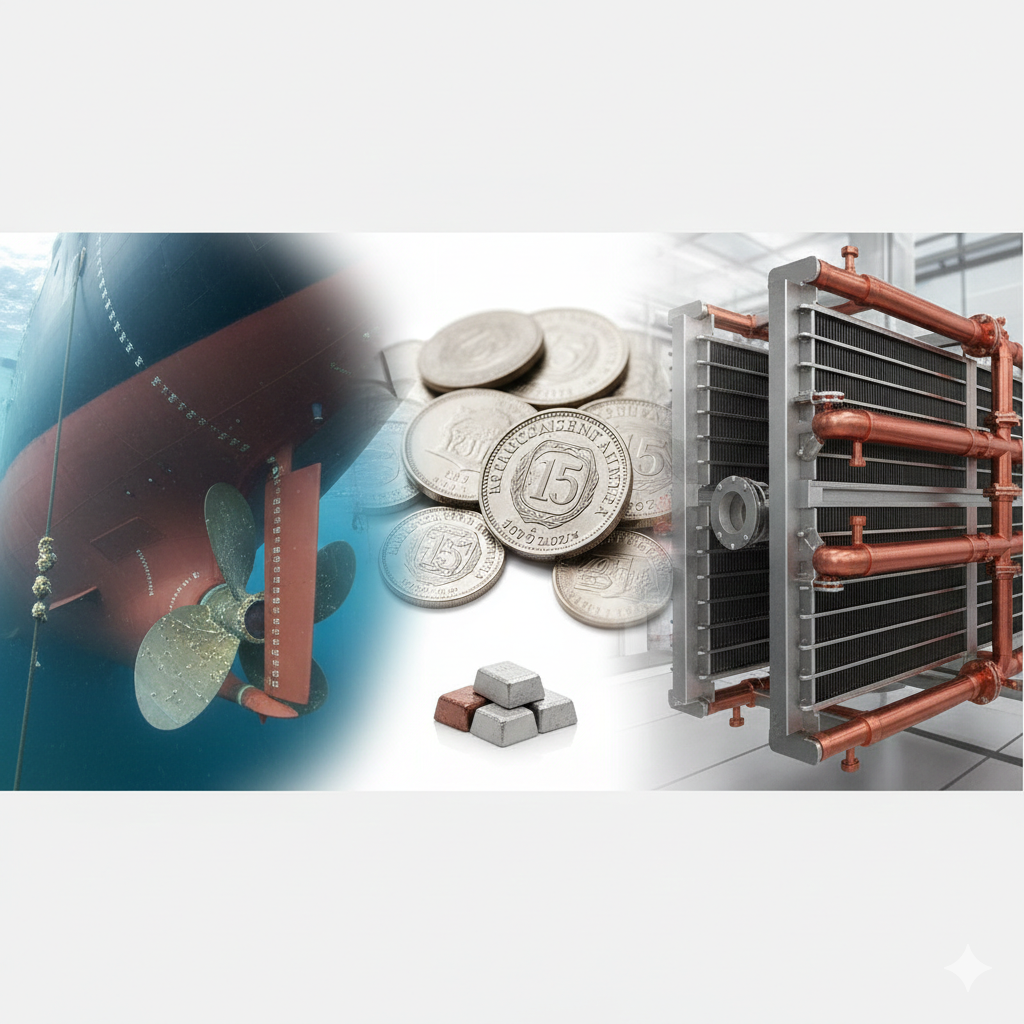
In the vast landscape of engineering materials, few alloys have proven as indispensable for marine and industrial applications as copper-nickel. For more than a century, these alloys have quietly enabled critical infrastructure—from naval vessels plying the world's oceans to desalination plants providing fresh water to millions. This deep dive explores the science behind copper-nickel alloys, examines their unique properties, surveys their diverse applications, and honestly assesses their limitations to provide engineers and decision-makers with the comprehensive understanding needed for informed material selection.
The Metallurgical Foundation: Understanding CuNi Chemistry
Copper-nickel alloys are primarily binary systems composed of copper and nickel, though commercial grades invariably include small amounts of additional elements that enhance specific properties. The fundamental metallurgical characteristic that makes these alloys possible is the complete mutual solubility of copper and nickel—these elements form a continuous solid solution across all composition ranges, from pure copper to pure nickel.
This complete solubility means that copper and nickel atoms can substitute for each other in the crystal lattice without forming brittle intermetallic compounds or creating phase boundaries that could compromise mechanical properties or corrosion resistance. The result is a homogeneous alloy with predictable, controllable properties that can be tailored by adjusting composition.
The two most commercially significant compositions are 90-10 CuNi (UNS C70600) containing nominally 90% copper and 10% nickel, and 70-30 CuNi (UNS C71500) with 70% copper and 30% nickel. These designations refer to the copper-nickel ratio, but commercial alloys contain important minor additions that significantly influence performance.
Iron additions, typically 1.0-2.0% in seawater-grade alloys, provide multiple benefits. Iron increases strength through solid solution hardening and forms fine precipitates that enhance resistance to erosion-corrosion—the mechanical-chemical attack that occurs in high-velocity fluid flows. The iron content must be carefully controlled; insufficient iron leaves the alloy vulnerable to impingement attack, while excessive iron can promote hard spot formation during welding.
Manganese, added at levels around 0.5-1.0%, serves as a deoxidizer during melting and contributes to strength. It also improves resistance to sulfur-bearing compounds that can attack copper alloys in certain environments.
Some specifications include small quantities of other elements—carbon for deoxidation, silicon for castability, or deliberate trace additions to optimize specific properties. The precise composition is tailored to the intended application, with marine grades emphasizing corrosion resistance and industrial grades sometimes prioritizing mechanical properties or thermal conductivity.
Corrosion Resistance: The Defining Advantage
The exceptional corrosion resistance of copper-nickel alloys in seawater environments represents their most significant and valuable property. This resistance stems from multiple complementary mechanisms that work together to provide robust, long-lasting protection.
When copper-nickel alloys are exposed to seawater, they develop protective surface films within days to weeks. Unlike the thin passive oxide films on stainless steels (typically 1-3 nanometers thick), CuNi surface films grow to hundreds of nanometers in thickness and consist of complex, multi-layered structures containing copper oxides, cuprous chloride complexes, nickel compounds, and incorporated seawater constituents including calcium carbonate and magnesium hydroxide.
These films are mechanically robust and tenacious, adhering strongly to the substrate and resisting erosion better than passive films on stainless steels. If damaged, the films reform relatively quickly, providing self-healing protection. The film formation process is accelerated by seawater flow, with well-developed protective films establishing faster in flowing seawater than in stagnant conditions.
The nickel content plays a crucial role in film stability and protective characteristics. While copper alone provides good corrosion resistance in seawater, the addition of nickel substantially improves film integrity, particularly at elevated temperatures and in more aggressive seawater conditions. The 10% nickel in 90-10 CuNi provides adequate protection for most ambient temperature seawater applications, while the 30% nickel in 70-30 CuNi extends the service envelope to higher temperatures (up to 80-100°C) and more aggressive conditions.
A unique and commercially valuable aspect of CuNi corrosion behavior is the alloy's inherent biofouling resistance. Copper ions released at the surface at very low rates—measured in micrograms per square centimeter per day—create conditions inhospitable to marine organism settlement and growth. Barnacles, mussels, algae, and bacterial biofilms that readily colonize stainless steel, titanium, and polymer surfaces show dramatically reduced attachment to copper-nickel.
This biofouling resistance is not merely cosmetic—it provides critical functional benefits. In heat exchangers, biological growth on heat transfer surfaces acts as an insulating layer that severely degrades thermal performance. A thin biofilm layer can reduce heat transfer coefficients by 30-50%, while heavy biological fouling can decrease efficiency by 70% or more. Additionally, biological deposits create occluded environments beneath them where aggressive chemistry can develop, promoting microbiologically influenced corrosion (MIC) that attacks even corrosion-resistant materials.
CuNi's resistance to biofouling maintains heat transfer efficiency throughout the service life, eliminates the corrosion acceleration associated with biological deposits, and reduces or eliminates the need for mechanical cleaning or chemical treatment to control growth. For systems operating continuously for years between maintenance opportunities, this advantage is transformative.
Thermal Performance: Heat Transfer Excellence
Copper ranks second only to silver in thermal conductivity among pure metals, with conductivity around 400 W/m·K. While alloying with nickel reduces this value, copper-nickel alloys retain thermal conductivity far superior to competing corrosion-resistant materials.
The 90-10 CuNi alloy maintains thermal conductivity approximately 50 W/m·K—roughly 12% of pure copper's conductivity but more than triple that of austenitic stainless steels like 316L (15-16 W/m·K). The 70-30 composition, with its higher nickel content, shows thermal conductivity around 29-30 W/m·K—still double that of stainless steel.
This thermal performance advantage has profound implications for heat exchanger design and operation. Higher thermal conductivity means higher overall heat transfer coefficients, enabling more compact heat exchangers with less surface area to achieve equivalent thermal duty. Alternatively, for a given heat exchanger geometry, higher conductivity delivers greater heat transfer capacity or enables operation with reduced temperature differentials.
In practical terms, a seawater-cooled condenser using CuNi tubes might require 30-40% less tube surface area than an equivalent stainless steel design to achieve the same heat rejection. This compactness reduces material consumption, decreases installation space requirements, and lowers capital costs—partially offsetting CuNi's higher material cost.
The thermal conductivity advantage also provides operational flexibility. Heat exchangers can handle greater thermal loads without exceeding design temperature limits, accommodate process upsets or variations in cooling water temperature, and maintain performance margins as fouling gradually accumulates over service life.
For power generation condensers, where fractions of a degree in temperature differential translate to measurable changes in thermal efficiency and electrical output, the superior heat transfer of CuNi tubes can improve overall plant thermal efficiency by 0.5-1.0 percentage points compared to less conductive alternatives—an advantage worth millions of dollars annually in a large generating station.
Mechanical Properties: Strength, Ductility & Fabricability
Copper-nickel alloys provide moderate strength levels adequate for pressure vessels, piping, heat exchangers, and structural components, combined with excellent ductility and toughness across a wide temperature range.
In annealed condition, 90-10 CuNi exhibits tensile strength typically 310-380 MPa, yield strength 110-170 MPa, and elongation 35-45%. The 70-30 composition shows higher strength: tensile strength 380-450 MPa, yield strength 150-200 MPa, with similar elongation. These properties position CuNi alloys as moderate-strength materials—stronger than commercial aluminum alloys but not approaching high-strength steels or precipitation-hardened alloys.
Cold working substantially increases strength. Light cold working (10-20% reduction) raises strength by 25-40%, while heavy cold working can double yield strength and increase tensile strength to 550-600 MPa. This work-hardening behavior allows manufacturers to tailor mechanical properties to application requirements through controlled deformation during tube drawing, sheet rolling, or wire forming operations.
The excellent ductility of CuNi alloys—maintained even after moderate cold working—provides several practical advantages. The material tolerates forming operations including bending, flaring, and expansion without cracking. This ductility enables tube-to-tubesheet joints in heat exchangers using roller expansion, a reliable, economical joining method. The material's toughness and ductility also provide resistance to shock loading, vibration, and impact—important for shipboard applications and mobile equipment.
CuNi alloys maintain good low-temperature properties without the ductile-to-brittle transition that affects carbon steels and some other materials. The face-centered cubic crystal structure of these alloys ensures continued ductility and toughness down to cryogenic temperatures, making them suitable for LNG service and other low-temperature applications where brittle fracture is a concern.
Fatigue resistance is adequate for most applications, though design must account for stress concentrations, fretting, and the influence of corrosive environments. In seawater, corrosion fatigue becomes the limiting condition rather than air fatigue, requiring appropriate design factors to ensure adequate service life under cyclic loading.
Marine Applications: The Natural Habitat for CuNi
The marine environment represents the primary application domain for copper-nickel alloys, where their property combination addresses challenges that have frustrated engineers working with alternative materials for decades.
Naval Architecture: Warships have used CuNi extensively since the early 20th century. The U.S. Navy specifies 90-10 CuNi for fire main systems that must deliver firefighting water throughout the vessel, reliably, for decades of service including combat conditions. The 70-30 composition serves in critical propulsion and auxiliary cooling systems where elevated temperatures and maximum reliability are required. Nuclear submarines use CuNi for seawater systems where failure could compromise vessel safety. The material's resistance to shock from weapons effects, reliability in unmaintained service for extended deployments, and freedom from catastrophic failure modes make it unmatched for critical shipboard applications.
Commercial Shipping: Cargo vessels, cruise ships, and offshore support vessels incorporate CuNi in seawater cooling systems, ballast piping, and bilge systems. The 25-30 year service life expectancy aligns with vessel economic life, eliminating costly mid-life system replacements that would require drydocking and extensive shipyard work.
Desalination Infrastructure: Thermal desalination plants processing millions of gallons daily rely on CuNi heat exchanger tubes as the critical component enabling seawater-to-freshwater conversion. Multi-stage flash (MSF) facilities use vast arrays of 90-10 CuNi tubes—a single large plant might contain 500,000 to over one million tubes representing hundreds of tons of CuNi. The combination of corrosion resistance, thermal conductivity, and biofouling resistance makes CuNi economically optimal despite material costs. The tubes must perform reliably for 20-30 years in continuous service with minimal maintenance—downtime in a desalination plant serving a city has profound consequences.
Offshore Petroleum Production: Production platforms use CuNi for seawater lift systems providing cooling water and process water, fire suppression systems requiring stored reliability for decades, and cooling loops for essential equipment. The harsh offshore environment, limited maintenance access, and safety-critical nature of these systems justify premium materials that will not fail unexpectedly.
Marinas and Harbors: Seawater intake structures, circulation systems for aquariums and aquaculture facilities, and cooling systems for waterfront facilities employ CuNi where reliable long-term performance in coastal waters is required.
Industrial and Commercial Applications Beyond the Sea
While marine applications dominate, copper-nickel alloys serve important roles in diverse industrial sectors exploiting their corrosion resistance, thermal properties, or antimicrobial characteristics.
Power Generation: Coastal and riverside power stations use enormous condensers to reject waste heat from steam turbines into cooling water. These condensers contain thousands of tubes through which cooling water flows—commonly 10,000 to 30,000 tubes in a single condenser. Many facilities worldwide specify CuNi tubes, particularly when using brackish or seawater cooling. The tubes must resist corrosion from cooling water on the outside and condensate on the inside, transfer heat efficiently, and operate reliably for decades. CuNi's combination of properties meets these demanding requirements more completely than alternatives.
Chemical and Petrochemical Processing: CuNi heat exchangers and piping handle process streams containing chlorides, organic acids, and various corrosive species. The alloys resist attack from hydrochloric acid at certain concentrations and temperatures, provide good service with organic acids, and tolerate exposure to hydrogen sulfide and mercaptans that can severely attack other copper alloys. The 70-30 composition extends the application range to more aggressive chemicals and higher temperatures.
Pulp and Paper Manufacturing: The aggressive chemistry of pulping and bleaching operations, combined with elevated temperatures and the presence of chlorides, creates challenging conditions for materials. CuNi heat exchangers in chemical recovery systems and process heating applications provide long service life where less resistant materials fail prematurely.
Hydraulic Systems: Water-based hydraulic fluids used in mobile equipment, steel mills, and industrial hydraulics can promote corrosion in steel tubing. CuNi lines resist corrosion while maintaining pressure ratings and fatigue resistance required for hydraulic service. The alloy's ductility accommodates vibration and bending without work-hardening to failure.
Pharmaceutical and Food Processing: The antimicrobial properties of copper-nickel, combined with corrosion resistance to cleaning chemicals and process fluids, make these alloys suitable for process equipment, heat exchangers, and fluid handling systems in industries requiring hygienic conditions. The material naturally inhibits bacterial growth while resisting the acidic and alkaline cleaning agents used for sanitation.
Fabrication, Joining and Installation Practices
Copper-nickel alloys are readily fabricated using conventional metalworking equipment and processes, though optimal results require understanding the material's characteristics and following appropriate practices.
Tube Manufacturing: The majority of CuNi is consumed as seamless tubing for heat exchangers. Tube production involves hot extrusion or piercing of cast billets, followed by cold drawing through multiple passes to achieve final dimensions and mechanical properties. Intermediate and final annealing treatments control hardness and ensure adequate ductility for installation operations. Quality control includes testing for dimensions, mechanical properties, and most critically, eddy current or hydrostatic testing to detect defects that could compromise service life.
Welding Technology: CuNi alloys are readily welded by gas tungsten arc welding (GTAW/TIG), gas metal arc welding (GMAW/MIG), and shielded metal arc welding (SMAW) using appropriate filler metals. The filler metal composition is specifically formulated with deoxidizers and often slightly elevated nickel content to compensate for dilution and ensure weld metal properties match or exceed base metal.
Welding procedures must address CuNi's high thermal conductivity—heat rapidly conducts away from the weld zone, requiring higher heat input than similar thickness steels. However, unlike copper alloys with even higher conductivity, preheating is generally unnecessary except for very heavy sections. Post-weld heat treatment is not required for corrosion resistance, simplifying fabrication.
Common welding defects include incomplete fusion from insufficient heat input, porosity from inadequate shielding gas coverage or surface contamination, and hot cracking in the weld metal if sulfur or other low-melting constituents are present. Proper joint preparation, cleanliness, and welding parameters prevent these issues.
Tube-to-Tubesheet Joints: Heat exchanger assembly requires leak-tight joints between thousands of tubes and the tubesheets supporting them. For CuNi tubes, roller expansion is the preferred method—a rotating mandrel with tapered rollers is driven into the tube end, plastically deforming both tube and tubesheet to create an interference fit and mechanical seal. The ductility of CuNi enables reliable expanded joints without cracking.
Alternatively, tubes can be welded to tubesheets, though this is more expensive and time-consuming. Explosive welding creates metallurgical bonds for the most critical applications. The joint method selection depends on application severity, design pressure, and economic considerations.
Cost Analysis and Economic Decision Framework
Copper-nickel alloys represent a premium material choice requiring careful economic analysis. Raw material costs fluctuate with commodity markets for copper and nickel, but CuNi typically costs 3-6 times more than austenitic stainless steels and 10-25 times more than carbon steel on a weight basis.
This cost differential raises obvious questions: why specify a material costing 4-5 times more than alternatives? The answer lies in lifecycle economics rather than initial capital cost.
Service Life Extension: CuNi systems routinely achieve 25-35 year service lives in seawater service where stainless steel alternatives might last 8-12 years before corrosion failures necessitate replacement. The avoided cost of mid-life replacement—including materials, labor, system downtime, and related disruptions—often dwarfs the initial material premium. A shipboard system requiring replacement during a scheduled 30-year service life might spend more on replacement and installation than the incremental cost of specifying CuNi initially.
Maintenance Cost Reduction: The biofouling resistance of CuNi dramatically reduces cleaning frequency and eliminates chemical antifouling treatments. A seawater cooling system might require tube cleaning every 6-12 months if using stainless steel, versus 2-5 years for CuNi. Over decades of operation, maintenance labor savings accumulate substantially.
Performance Reliability: Unexpected failures create costs far exceeding material values—emergency drydocking of a ship, unplanned shutdown of a power plant, or loss of critical process cooling in an industrial facility. CuNi's predictable, stable corrosion behavior reduces the probability of surprise failures and their associated costs.
Energy Efficiency: For power generation condensers, the superior thermal conductivity of CuNi translates to improved plant thermal efficiency. A one percentage point improvement in heat rate for a 500 MW coal plant might be worth $2-4 million annually in fuel savings—value that accumulates year after year, dwarfing the material cost premium.
The economic decision framework must weigh these lifecycle benefits against initial cost premium, discounted appropriately for project economics. For critical infrastructure with long design life expectations, high downtime costs, and significant maintenance expenses, CuNi consistently demonstrates favorable lifecycle economics despite its premium initial cost.
Critical Limitations: Understanding the Boundaries
No material is universally optimal, and copper-nickel alloys have distinct limitations that constrain their application range and necessitate alternatives in specific circumstances.
Velocity-Induced Erosion-Corrosion: The most significant limitation of CuNi alloys is their susceptibility to erosion-corrosion—the combined mechanical and chemical attack that occurs at high fluid velocities. When seawater velocity exceeds critical thresholds, the protective surface film cannot maintain integrity against the mechanical forces, and accelerated corrosion occurs.
Maximum recommended seawater velocities are approximately 2.5 m/s for 90-10 CuNi and 3.5 m/s for 70-30 CuNi under continuous operation. These velocity limits constrain piping and heat exchanger design, requiring larger diameters and more tubes than would be necessary with velocity-tolerant materials like titanium (which handles 6-8 m/s) or super-austenitic stainless steels.
The velocity sensitivity is particularly problematic in retrofit applications where existing piping layouts dictate flow velocities. If those velocities exceed CuNi limits, alternative materials must be specified regardless of CuNi's other advantages.
Ammonia Incompatibility: Copper alloys, including CuNi, are severely susceptible to stress corrosion cracking (SCC) in environments containing even trace quantities of ammonia. Ammonia exposure can cause rapid, catastrophic cracking of stressed components—failures can occur within hours of exposure under worst-case conditions.
This sensitivity absolutely prohibits CuNi use in refrigeration systems using ammonia refrigerant, chemical processes involving ammonia, and any application where ammonia contamination is possible. Agricultural facilities, wastewater treatment plants, and certain industrial environments may have ambient ammonia that excludes CuNi from consideration.
The ammonia sensitivity is insidious because very low concentrations—parts per million in some cases—can cause cracking. Designers must rigorously exclude any possibility of ammonia exposure when specifying CuNi.
Sulfide Attack in Stagnant Conditions: While CuNi resists general corrosion in flowing seawater, stagnant or low-flow conditions allowing bacterial sulfate reduction and sulfide accumulation can cause localized corrosion. Harbors with high organic content, enclosed basins with poor water circulation, and systems experiencing extended shutdown periods may develop sulfide-rich conditions attacking CuNi.
Design practices that ensure adequate minimum velocities, periodic flushing during shutdown, and attention to flow distribution prevent sulfide-related problems. However, systems that will experience long stagnant periods may require alternative materials.
Galvanic Corrosion Considerations: When CuNi is electrically connected to more active metals (steel, aluminum, zinc, magnesium) in seawater, galvanic corrosion accelerates attack on the more active material while the CuNi remains protected. The nobility of CuNi in the galvanic series creates challenges for system design involving multiple metals.
Common mitigation strategies include electrical isolation using insulating gaskets and bushings, use of sacrificial anodes to protect active metals, and coating or painting of dissimilar metal areas. In some cases, the galvanic interaction is accepted and managed through planned replacement of sacrificial components.
Temperature Limitations: Above approximately 250-300°C, CuNi alloys begin losing strength and experiencing accelerated oxidation. High-temperature applications exceeding these limits require nickel-based superalloys, stainless steels, or other refractory materials. The practical temperature ceiling for CuNi in seawater service is around 150°C for 70-30 composition.
Strength Constraints: Applications requiring yield strengths exceeding 350-400 MPa or ultimate strengths above 600 MPa exceed CuNi capabilities even with cold working. High-pressure vessels, structural members under heavy load, and components subject to extreme mechanical stresses may require higher-strength materials despite corrosion resistance compromises.
Alternative Materials: Comparative Context
Understanding when CuNi is optimal requires examining competing materials and their trade-offs.
Austenitic Stainless Steels (316L, 317L): These alloys cost 25-40% of CuNi prices and offer good general corrosion resistance. However, they lack biofouling resistance, have lower thermal conductivity, and are prone to pitting, crevice corrosion, and SCC in warm seawater (above 30-40°C). Service life in seawater is typically 8-15 years versus 25-35 for CuNi.
Super-Austenitic Stainless Steels (254 SMO, AL-6XN): These high-alloy stainless steels provide improved seawater resistance versus standard grades and tolerate higher velocities (4-5 m/s). However, they cost 60-80% of CuNi prices, still lack biofouling resistance, and have lower thermal conductivity. They represent a middle ground for applications where CuNi cost is prohibitive but standard stainless steel is inadequate.
Titanium: This material offers outstanding corrosion resistance, immunity to biofouling-related corrosion, and tolerance for very high velocities (6-8 m/s). However, titanium costs 2-3 times more than CuNi and has very low thermal conductivity (16-20 W/m·K)—actually lower than stainless steel. The conductivity penalty severely compromises heat transfer performance. Titanium is optimal when maximum corrosion resistance and high velocity tolerance justify the cost premium and heat transfer sacrifice.
Aluminum Brass (C68700): This copper-zinc-aluminum-arsenic alloy costs 60-70% of CuNi and provides good seawater resistance with biofouling resistance. However, it is limited to lower temperatures (below 60°C), has velocity limits similar to 90-10 CuNi, and provides somewhat shorter service life. Aluminum brass serves applications where moderate cost savings are valuable and temperature/service life requirements are not demanding.
Material selection must balance these trade-offs against specific application requirements, lifecycle economics, and risk tolerance.
Conclusion: The Enduring Value of Copper-Nickel Alloys
Copper-nickel alloys have maintained their position as premium materials for demanding marine and industrial applications for over a century—a longevity that reflects fundamental metallurgical advantages rather than historical momentum. The combination of exceptional seawater corrosion resistance, intrinsic biofouling resistance, excellent thermal conductivity, good fabricability, and predictable long-term performance creates a property profile that remains unmatched for specific application requirements.
The material's limitations—velocity sensitivity, ammonia incompatibility, cost premium—are well understood and manageable through proper design and application engineering. For infrastructure designed for multi-decade service lives where reliability, minimal maintenance, and performance stability are paramount, the lifecycle economics consistently favor CuNi despite its material cost premium.
As global population growth drives demand for desalination capacity, aging naval fleets require replacement, and industrial facilities prioritize reliability and efficiency, copper-nickel alloys will continue serving as the material of choice for critical seawater applications. The metallurgical principles underlying their performance are timeless, and no emerging materials currently threaten their dominance in applications where their property combination delivers maximum value.